23 June 2016

IT'S KIND OF NICE TO KNOW THAT BLOOMBERG HAS SIMILAR VIEWS AS I

Free Malaysia Today carries an article citing Bloomberg as saying that Malaysia's rural voters will decide which party wins the next elections.

Well, it's good to know that Bloomberg and several other political analysts share the same views on this issue with this humble, semi-retired, former writer who once specialised in writing about the information and communications technology (ICT) industry.

This understanding  is not new and many who have been active in or who have observed politics on the ground in rural, semi-rural and semi-urban areas already know this, and also that people living, working and running businesses in these areas have different perspectives, priorities and values from more affluent and sophisticated urbanites.

Back in January 2011, a controversy flared over the historical novel Interlok being derogatory towards ethnic Indians of Malaysia, and it was one of the books in the school reading syllabus which made the controversy even more hot, with articles about it appearing on Free Malaysia Today's website almost daily and in other print and online media as well.

Meanwhile, reporters from Free Malaysia went down to cover the campaigning in the run up to the by-election for the state seat of Tenang. a small rural town in northern Johor state on 30 January 2011 and they asked some ethnic Indians there what they thought about Interlok and some Indians there said that they had not heard about Interlok, whilst others who did told the reporters that yes they had heard about the Interlok controversy but they had bigger concerns over their economic survival to have time to be bothered with a mere book, to its credit Free Malaysia Today reported.

Now that was way back in 2011 and we still have some clowns, especially from the opposition parties and opposition supporters who go around places like Tenang, Sungai Besar, Kuala Kangsar, recently in Sarawak, etc,  using issues which urbanites are preoccupied with to try convince voters there to vote from them.

Their approach here is to demonise the incumbent, rather than try to convince the voters that the opposition can do a better job of serving their interests if elected.

So they usually lose in these areas but continue on repeating their failed approach, over and over again, perhaps hoping that one fine day, the proverbial needle of their proverbial turntable will somehow become unstuck from the rut in the damaged proverbial vinyl record playing on their proverbial turntable at the time, and the opposition party finally goes on to beat the incumbent party for the seat.

So without further ado, below is the story by Free Malaysia Today.

CHARLES F MOREIRA

Rural votes to decide next General Election victor

FMT Reporters A Bloomberg report says farmers and land settlers favour Umno as they say government policies have helped improve their lives.


Bloomberg_petani_undi_600

KUALA LUMPUR: The rural population is well-taken care of by the Government, which is why the Barisan Nasional (BN) does consistently well in rural areas.

And that is why Prime Minister Najib Razak continues to court farmers and works to keep smallholders and Felda settlers happy.

According to a Bloomberg report, Najib needs to keep smallholders happy as he seeks the votes of rural and semi-urban areas to retain power in the next General Election due by 2018.

“Farmers — many of them ethnic Malays — are a linchpin for his party, which leads one of the world’s longest-ruling coalitions. Their votes have a higher weighting than their work, which contributes to less than a tenth of gross domestic product.”

The report said, at the next General Election, Najib would probably further target the bottom 40 per cent of the population who can swing votes in tight races.

19 June 2016

STATUS QUO IN SUNGAI BESAR AND KUALA KANGSAR

So, as expected, the Barisan Nasional  (BN) coalition held Sungai Besar and Kuala Kangsar in the byelections held of 18 June 2016 with slightly larger majorities in percentage terms, with lower voter turnouts in both parliamentary constituencies.

In Sungai Besar, Selangor, the BN increased its votes by 3.12 percentage points from 50.53% of 36,991 votes in the May 2013 general elections to 53.65% of 31,311 votes in the June 2016 byelection.

In Kuala Kangsar, Perak, the BN gained 0.21 percentage points from 51.14% of 27,801 votes in the May 2013 general elections to 51.35% of 23,274 votes in the June 2016 byelection.

These results were in a four cornered fight in Sungai Besar in June 2016 over a straight one on one fight in May 2013 and a four cornered fight in Kuala Kangsar in June 2016 versus a three cornered fight in May 2013.

Despite some sensationalist media reports of a "massive majority" for the BN in Sungai Besar in June 2016, this result shows more or less status quo for the BN in these two constituencies, given that Amanah is a recent breakaway faction of PAS.

The results tabulated below suggest that PAS voters in 2013 remained loyal to PAS and Amanah in June 2016, with votes split between the two, whilst BN voters in 2013 remained loyal to BN in 2016.


SUNGAI BESAR, SELANGOR BYELECTION RESULTS 18 JUNE 2016
CANDIDATE
PARTY
VOTES
% VOTES
Budiman Modh Zohdi
BN
16,800
53.65
Dr. Abdul Rani Osman
PAS
6,902
22.04
Azhar Abdul Shukur
Amanah
7609
24.30


TOTAL VOTES
31,311


SUNGAI BESAR, SELANGOR ELECTION RESULTS MAY 2013
CANDIDATE
PARTY
VOTES
% VOTES
Noriah Kasnon
BN
18,695
50.53
Mohd Salleh M Husin
PAS
18,296
49.46


TOTAL VOTES
36,991


KUALA KANGSAR, PERAK BYELECTION RESULTS 18 JUNE 2016
CANDIDATE
PARTY
VOTES
% VOTES
Mastura Mohd Zahid
BN
12,653
51.35
Dr Najihatussalehah Ahmad
PAS
5,684
24.42
Prof Dr Ahmad Termizi Ramli
Amanah
4,883
20.98
Izat Bukhary Ismail Bukhary
Independent
54
0.23


TOTAL VOTES
23,274


KUALA KANGSAR, PERAK ELECTION RESULTS MAY 2013
CANDIDATE
PARTY
VOTES
% VOTES
Wan Mohd Khairil Anuar Wan Ahmad
BN
14,218
51.14
Khalil Idham Lim Abdullah
PAS
13,136
47.25
Kamilia Ibrahim
Independent
447
1.60


TOTAL VOTES
27,801


In the aftermath of this result, Free Malaysia Today reports that the Pakatan Harapan pact wants PAS back at the negotiating table, now that they realise that they do not have a chance of beating the BN in the 2018 general elections without PAS.


Pakatan Harapan wants PAS back at negotiating table

Mohamad Fadli Opposition should avoid three-cornered fights as people want the coalition to be strong.
KUALA KANGSAR: The defeat of Parti Amanah Negara (Amanah) in the Kuala Kangsar by-election is a sign that people want the coalition to be strong, Amanah Deputy President Salahuddin Ayub said.

He added that Pakatan Harapan was open to inviting PAS back to the negotiating table.

“There is still time to repair things.

“We are always open to discussions with PAS,” he said at a press conference at the Amanah Perak headquarters immediately after the Election Commission (EC) announced the results of the Kuala Kangsar by-election.

Barisan Nasional (BN) candidate Mastura Mohd Yazid won the parliamentary by-election after defeating candidates from Amanah, PAS and an Independent.

Mastura emerged victorious with a majority of 6,969 votes, recording a significant increase compared to the last general election.

Meanwhile, DAP’s Taiping MP, Nga Kor Ming also agreed with Salahuddin that PAS return to the discussion table with Pakatan Harapan.

He said the three-cornered fight clearly affected the Opposition’s chances of defeating BN.

“PAS has to go into negotiations with Pakatan Harapan. If PAS does not want to lose, they should avoid three-cornered fights. We are always open, but PAS should be sincere.”

Meanwhile, Nga claimed that 300 loyal DAP voters who wanted to support the Amanah candidate were transferred to the Padang Rengas parliamentary constituency.

He said the EC had acted unfairly and this was one of the reasons Pakatan Harapan had lesser votes.

http://www.freemalaysiatoday.com/category/nation/2016/06/19/pakatan-harapan-wants-pas-back-at-negotiating-table/

Now why didn't they figure that out earlier.

Let's wait and see how they work this one out, if they can work it out.


Charles F. Moreira


18 June 2016

THE VOICES WHICH MOST LIBERALS AND "PROGRESSIVES" EITHER DENOUNCE OR IGNORE

Less than a week from now, United Kingdom people will vote in a referendum on 23 June 2016, on whether the United Kingdom will leave or remain in the European Union.

For those who are unaware, Great Britain comprises England, Scotland and Wales, whilst the United Kingdom comprises England, Scotland, Wales and Northern Ireland. So whilst people are in the habit of using the names "Britain" and "United Kingdom" interchangeably, they actually are different entities, just as "Malaya" and "Malaysia" are names of different entities, whereby Malaya (now known as Peninsular Malaysia) is a subset of Malaysia.)

This comes 43 years after the UK was accepted into the EU (then known as the European Common Market) in 1973, and 41 years after two-thirds of UK citizens voted in a referendum, in favour of renegotiated terms of membership of the EU.

Results from public opinion polls today suggest that that there is a good likelihood that UK citizens could well vote to leave the EU and there are plenty of opinions arguing for or against, and many media commentators, economists and politicians predicting better or worse consequences for the UK economically, should the referendum result in a vote to leave.

However, whilst the views of these largely intellectual and urban-based commentators are widely publicised in the mainstream media, the voices of those amongst the UK working class, mostly in the more impoverished parts of the UK such as the north of England, the East End of London, to some extent part of the Midlands, northern Wales and Scotland are rarely heard.

I was a student in Salford, a part of Greater Manchester back in the 1970s. Salford is said to be at the heart of the industrial revolution and was reputed to be Europe's biggest slum and I saw evidence of poverty and run down houses in the working class areas of Salford, where in some cases there were no indoor toilets, where children ate out of garbage and so on.

Now writing in The Guardian, Lisa Mckenzie who comes from a working class background reveals why the UK working class favours that Britain (well actually the United Kingdom) will vote to leave the EU in the referendum, in what is commonly referred to a "Brexit" or "Britain Exit).

In her article which follows after this commentary, Mckenzie reveals that whilst UK workers are concerned over issues such as immigration, as the mainstream media portrays them, however their bigger concerns are over their economic security and well being.

She quotes a group of east-London women as saying, “I’m sick of being called a racist because I worry about my own mum and my own child,” and “I don’t begrudge anyone a roof who needs it but we can’t manage either.”

We don't have to go all that far from Malaysia to hear those kinds of accusations of "ignorant", "racist" and so forth spouting from the mouths and keyboards of largely urban based Malaysian liberals and "progressives", with such denunciations having been hurled at the Sarawak voters, more of whom voted for Sarawak-based coalition partners in the Barisan Nasional (National Front) coalition in the recent Sarawak state elctions.  Besides economic concerns which no doubt was a factor in this result, Sarawakians (and Sabahans) are very protective of their respective states' territory integrity and don't quite welcome intrusion from Peninsular Malaysia, so they voted for their native Sarawak parties which are members of the ruling Barisan Nasional coalition - a formal coalition of 13 parties, rather than candidates of opposition parties from Peninsular Malaysia.

It may surprise non-Malaysians to know that whilst Sarawakians and Sabahans can freely live and work in Peninsular Malaysia without having to obtain a work permit, a Peninsular Malaysian needs a work permit to work in Sabah or Sarawak and that it is easier for a Peninsular Malaysian to obtain permanent residence in the UK, Australia, Canada and New Zealand, than it is for us to obtain permanent residence in Sarawak or Sabah.

The byelections in Sungai Besar and Kuala Kangsar will be held today (18 June) to elect replacements for the two members of parliament killed in a helicopter crash in Sarawak during the run up to the Sarawak state elections.

It is predicted that the United Malays National Organisation (UMNO), could likely hold these two seats, either with the same slim majorities or as some predict, an increased majority. Well, if that happens, just watch the torrent of denunciations of these semi-urban voters as "ignorant", "racist", "stupid" and so forth from the largely urban-based keyboard warriors, "alternative" media and the commentators to articles on these "alternative" media - a relatively privileged, urban elite who care little about the economic concerns of lower income people and who rarely offer alternative solutions for such people, which runs counter to their mostly neo-liberal leanings towards Darwinist-style "survival of the fittest" and "the rest be damned".

For such people, any kind of financial assistance and programmes to help alleviate poverty are anathema to their neo-liberal dogma of meritocracy, so how on earth can they expect to win votes from such constituents.

Instead, they tout alleged misdeeds of key government figures with regards issues such as 1MDB, RM2.6 billion donation, Altantuya, etc, etc, etc. and they hope to win based upon these issues!

Well, their stupidity is beyond belief.

Such neo-liberal policies have held sway in Europe, North America and elsewhere in the world, especially since the time of Margaret Thatcher and Ronald Reagan, since when the rich got richer and the poor got poorer but in their neo-liberal minds, they either believed that such people could so easily upgrade their skills and "move up the value chain" to better paying jobs, but they did not see or want to see that there are fewer opportunities up the value chain and that instead, there would be more graduate unemployment or under-employment in lower paying service jobs which degree holders have to accept just to survive.

It was a long time coming, but the proverbial worm has now turned, and it is not pretty, when in their frustration such people in Europe have swung to the far-right, such as in the recent Austrian presidential elections where the centre-left Green Party candidate barely won over the far-right candidate by a wafer thin margin of 0.6% and in the United States, there is the high likelihood that radical right populist Donald Trump could be elected the next President of the United States in November.

It is reported that many working class Austrians who used to vote for the social democrats now voted for the populist far-right candidate in the presidential elections. This of course could be a protest vote, which may not be repeated in a general elections but still, sends a message of great dissatisfaction with the status quo on the part of the Austrian workers.

In this two-part Real News Network video documentary, Walter Baier, an economist, a communist and now Coordinator for Network to Transform Europe explains the rise of the far-right as resulting more from socio-economic concerns and sense of betrayal by the traditional mainstream conservative, social democratic and liberal parties especially amongst the working class and middle class, rather than over concerns over the massive influx of refugees and fear of Islam. Baier goes on to describe how the conservatives, social democrats and liberals have implemented neo-liberal policies and have implemented policies of austerity.

Baier who was a Chairman of the Communist Party of Austria describes how weak the far-left is today, so people have no recourse to turn to on the far-left which could serve as a counterweight to the far-right.

He also explains the rise of the far right as resulting of popular concerns over the growing supra-national dominance of the European Union over the social and economic policies imposed upon the member nation states of the European Union. 

https://www.youtube.com/watch?v=2JlsyHc0-dc

https://www.youtube.com/watch?v=SehG1B75x2Q

To understand the difference between their respective policies and policies and ideologies, social democrats (often called "socialists") believe in the gradual transformation of capitalist society and economy through laws in favour of the working class and their trade unions but in practice, they have mainly fought for better conditions for workers within the capitalist system. However, after the wave of neo-liberal capitalist policies which have swept the world, especially since Thatcher and Reagan, the social democrats have ended up implementing neo-liberal policies and have imposed austerity policies upon the people, perhaps with a "more human face".

Communists believe in the replacement for the capitalist system which is based upon private ownership of the means of production, distribution and exchange, in which production is for private profit, with a socialist political and economic system in which the means of production, distribution and exchange are socially owned and in which production is for social need. And when the economic basis is different, the economic laws which arise from it will be different too, so where an economy based on production for private profit experiences periodic crises of overproduction, hence the capitalist economy goes through a roller coaster of booms and recessions, with workers being hired and retrenched as a consequence. On the other hand a planned economy based upon production for social need, will operate according to different economic laws from those laws arising from a capitalist economy.

Many misunderstand economic laws to be immutable like the laws of physics, chemistry and mathematics, when like with social and political science, economics is an inexact science, in which its laws or more particularly the behaviour of an economy arises from its underlying principles upon which an economy is based, and very much depends upon the forces of supply, demand, sentiment, finance, industry, productive capacity and so forth within the foundation of a particular economy and its inter-relation with the forces of supply, demand, sentiment, finance, industry, trade and so forth within the rest of the world.

The far-right (often referred to as fascists), are actually closer to the social democrats in that they policies of maintaining a capitalist economy, but a highly regulated one which includes a certain degree of state ownership of key industries and which serves the higher interests of the nation state, and to win and maintain the support of the small businesses, professionals and the workers for the nation state, the far-right provides them with certain social benefits and programmes in areas of housing, healthcare, education, old-age pensions and so forth. Whilst far-right regimes usually deny the independence of trade unions and instead replace them with unions which the government or ruling far-right party controls. In place of confrontation between workers and capitalists, a far-right regime enforces class collaboration in the higher interests of the nation state.

In fact, Singapore under the Peoples Action Party has adopted many of these far-right policies of class collaboration and socio-economic provision based upon a foundation of a capitalist economy. Instead of labour disputes, Singapore has strong labour laws and unions there generally rely on recourse to the labour court and arbitration to settle industrial disputes.

Therefore it is not surprising that unlike before World War II, when the far-left was very powerful with strong links to organised labour especially in Europe and also in North America and elsewhere, today with few exceptions, the far-left especially in Europe, the Americas and other parts of the world is mostly highly fragmented, with many squabbling factions , which despite their resolutions, statements and participation in mass demonstrations and public rallies, however have little or no influence or organisation within the core of the working class, hence the working class swing to the far-right.

This is partly due to much of today's far-left parties and groups having begun within the student movement or some other segments of society besides the organised working class, so they have difficulty gaining traction within working class and leading it to fight for its own interests.

Thus, such far-left parties and organisations resort to winning support and members from ethnic minorities in anti-racist and anti-fascist struggles, from women in their fight for equality, from religious minorities in defence of their rights,  from lesbian, gay, bi-sexual and transgender (LGBT) in their fight for equal rights and against discrimination, through anti-imperialist and anti-war struggles and so forth.

Whilst participating in these struggles and sometimes playing a leading role in them is fine, however they are peripheral to the economic concerns and struggles of the core of the working class to defend its interests, and without the influence within and the support of the core, such far-left parties and groups have not grown significantly beyond their niche of influence and support.

So when the far-left cannot do much to lead the people to resist neo-liberal austerity measures being imposed upon them by their conservative, liberal or social democratic government and along comes the far right with promises to protect their jobs, public healthcare, public education, public housing, to protect their national, ethnic, religious and cultural identity and to solve problems within the economy, it is no surprise that especially during hard economic times like now, people in difficult economic straits will very likely turn to the far-right for recourse.

Whether they deliver on their promises if they win is left to be seen but until then, such people will believe them and no amount of denunciation of the far-right as being racist, fascist, Islamophobic, anti-Semetic, homophobic, Islamophobic, reminders of the Holocaust, etc. will be likely to change such people's minds, especially when they looking for a government which will relieve them their suffering due to hard economic conditions.

The bottom line in all this is the state of the each country's economy and the global capitalist economy as well.

Lisa Mackenzie's article follows below.

Charles F Moreira

Brexit Is The Only Way the Working Class Can Change Anything

Working-class people are sick of being called ignorant or racist because of their valid concerns. The EU referendum has given them a chance to have their say.

By Lisa Mckenzie

June 15, 2016 "Information Clearing House" - "The Guardian" - I have lived in working-class communities all my life, and now that I research and write about those communities as a working-class academic, my motivation has always been to make sure that an authentic working-class woman’s voice tells our stories.

Working-class people’s voices are rarely heard outside their communities, and almost never within the political or media sphere. However the EU referendum debate has opened up a Pandora’s box of working-class anger and frustration. It is clear that the Westminster politicos are quite unnerved by this. Even I am surprised by how the referendum has captured the attention and the imagination of the same people that only last year told me they had no interest in the general election “because ‘they’ are all the same”.

Some 13 months later they are asking me what I think and arguing with me about the finer points of Brexit. In working-class communities, the EU referendum has become a referendum on almost everything. In the cafes, pubs, and nail bars in east London where I live and where I have been researching London working-class life for three years the talk is seldom about anything else (although football has made a recent appearance). In east London it is about housing, schools and low wages. The women worry for their children and their elderly parents – what happens to them if the rent goes up again? The lack of affordable housing is terrifying.

In the mining towns of Nottinghamshire where I am from, the debate again is about Brexit, and even former striking miners are voting leave. The mining communities are also worried about the lack of secure and paid employment, the loss of the pubs and the grinding poverty that has returned to the north. The talk about immigration is not as prevalent or as high on the list of fears as sections of the media would have us believe. The issues around immigration are always part of the debate, but rarely exclusively.

From my research I would argue that the referendum debate within working-class communities is not about immigration, despite the rhetoric. It is about precarity and fear. As a group of east London women told me: “I’m sick of being called a racist because I worry about my own mum and my own child,” and “I don’t begrudge anyone a roof who needs it but we can’t manage either.”

Over the past 30 years there has been a sustained attack on working-class people, their identities, their work and their culture by Westminster politics and the media bubble around it. Consequently they have stopped listening to politicians and to Westminster and they are doing what every politician fears: they are using their own experiences in judging what is working for and against them.

In the last few weeks of the campaign the rhetoric has ramped up and the blame game started. If we leave the EU it will be the fault of the “stupid”, “ignorant”, and “racist” working class. Whenever working-class people have tried to talk about the effects of immigration on their lives, shouting “backward” and “racist” has become a middle-class pastime.

Labour’s ‘metropolitan elite’ risks losing Eurosceptic supporters to Ukip by ignoring their views on Europe, claims MP Frank Field


Working-class people in the UK can see a possibility that something might change for them if they vote to leave the EU. The women in east London and the men in the mining towns all tell me the worst thing is that things stay the same. The referendum has become a way in which they can have their say, and they are saying collectively that their lives have been better than they are today. And they are right. Shouting “racist” and “ignorant” at them louder and louder will not work – they have stopped listening.

For them, talking about immigration and being afraid of immigration is about the precarity of being working class, when people’s basic needs are no longer secure and they want change. The referendum has opened up a chasm of inequality in the UK and the monsters of a deeply divided and unfair society are crawling out. They will not easily go away no matter what the referendum result.


http://www.informationclearinghouse.info/article44880.htm

16 May 2016

RETIRED TEACHER WHOSE CAR FELL INTO SEWERAGE SHAFT DIES

The retired teacher whose car fell into a 12 metre deep sewerage reticulation shaft in Petaling Jaya dies in hospital, the New Straits Times reports.

As far as I know, this is the first time that there has been a fatality related to the Petaling Jaya North Sewer which is under construction in and around my vicinity.

None of the "alternative" media carried reports about this unfortunate death. I suppose it is not "sexy" enough for them.

Correction: Free Malaysia Today carried reports about Mr. Yong's passing, though searching for them is like searching for a needle in a haystack.

On 15 May, Free Malaysia Today reported:-

Ex-headmaster Yong dies after PJ manhole accident

And on 16 May, Free Malaysia Today reported:-

Over 100 pay respects to construction hole crash victim

Earlier New Straits Times report referred to follows below:-

Senior citizen whose car fell into PJ sewage hole, dies

By Hariz Mohd - 15 May 2016 @ 6:58 PM

PETALING JAYA: An octogenarian whose car plunged into a 12m-deep sewage hole in Section 17, here, on May 3, died in hospital earlier today. District police chief Assistant Commissioner Mohd Zani Che Din said the victim - Yong Chee Seng, 86, was pronounced dead by doctors at the Universiti Malaya Medical Centre, here, about noon. "The victim died at UMMC about noon today. A post-mortem will be conducted tomorrow to ascertain the cause of his death," he told the New Straits Times when contacted. Mohd Zani said the post-mortem is expected to be conducted tomorrow (Monday). He said Yong, a retired headmaster, had been warded at the hospital for treatment ever since he was rushed there after the accident. The May 3 incident happened about 2pm when Yong lost control of his Toyota Vios and crashed through safety barriers before it plunged into the uncovered sewage hole at Jalan 17/14. Yong was heading home with his Filipino maid after dropping his sister off at her condominium in SS2 here. The victim was reported as saying that he had injured his neck in the accident, while the 30-year-old maid sustained injuries to the right eye. They were rescued by a team of firemen from Damansara Fire and Rescue Station, who used a winch to pull out the Vios. 1666 reads An octogenarian whose car plunged into a 12m-deep sewage hole in Section 17, here, on May 3, died in hospital earlier today. Pix by Hani Shamira An octogenarian whose car plunged into a 12m-deep sewage hole in Section 17, here, on May 3, died in hospital earlier today. Pix by Hani Shamira

Read More : http://www.nst.com.my/news/2016/05/145747/senior-citizen-whose-car-fell-pj-sewage-hole-dies

In another report, The Sun demands that the contractors be held responsible for this unfortunate accident and provides greater detail about the incident.

Hold them responsible Posted on 15 May 2016 - 08:07pm
Last updated on 16 May 2016 - 12:01am Lee Choon Fai and Haikal Jalil
newsdesk@thesundaily.com

PETALING JAYA: Various quarters today called for strict action to be taken against contractors who are negligent in ensuring public safety when carrying out public works.

This follows the death of 86-year-old former Methodist Boys School headmaster Yong Chee Seng, whose car had plunged into an uncovered 12m-deep pipe-jacking pit on May 3. Yong died at 11pm on Saturday at the University Malaya Medical Centre (UMMC) where he was warded.

Yong and his 30-year old maid, who was in the car with him, were earlier reported to have suffered head and body injuries following the accident.

The accident and Yong's death have aroused strong reactions from government agencies and concerned citizens alike who called for stricter enforcement and action against errant contractors.

"His body could not take the trauma caused by the accident due to his advanced age; he even suffered a major heart attack in the morning on the day before he passed away," said Yong's cousin Key Soon Yue, who called for heads to roll over the incident.

"The hole was not covered and the barriers were just cones. Those responsible must be penalised, even charged in court," Key told theSun.

Meanwhile, National Institute of Occupational Safety and Health (Niosh) chairman Tan Sri Lee Lam Thye said that the pit, which was to facilitate the laying of underground pipes, must be covered when construction was not going on and surrounded with concrete barriers instead of just cones which can be knocked down easily.

He called on local authorities to review regulations and conditions imposed on contractors in the interest of public safety.

"More often than not, contractors merely pay lip service to safety just to get their projects approved and the lack of safety is immediately apparent if one is to inspect the work sites. The state of safety management is deplorable!" said Lee.

Road Safety Department (RSD) director general Abd Ghafar Yusof said stricter enforcement was needed by local councils so contractors would follow safety standards.

"Any contractor who fails to adhere to safety standards has to be identified and penalised immediately. It is not good enough to take action only after someone gets hurt," he said.

Road Transport Department (RTD) enforcement director Datuk Valluvan Veloo said the RTD would engage with local councils and the Urban Wellbeing, Housing, and Local Government Ministry (KPKT) to improve safety near work sites.

He said RTD viewed Yong's accident seriously and was very concerned with the low level of safety seen at several construction sites on public roads.

"I often wonder if local councils conduct checks on roadworks in ensuring adequate safety measures are practised," said Valluvan.

Universiti Putra Malaysia (UPM) civil engineering professor Law Teik Hua suggested that local authorities come up with strict, comprehensive safety guidelines so that contractors would know exactly what they need to do.


http://www.thesundaily.my/news/1802654

Former Prime Minister Tun Abdullah Ahmad Badawi is right when he said that Malaysia "has a "first world infrastructure with a third world mentality".

Good question by Datuk Valluvan Vello - i.e. what was the local council - i.e. the Petaling Jaya City Council (MBPJ) doing to ensure better road safety at such work sites.

Deepest condolences to his family and loved ones. Hopefully they will be able to get more than adequate compensation for their tragic loss.

May God bless his soul.

Charles F. Moreira


KUALA LUMPUR CITY HALL WILLING TO INVESTIGATE ALLEGED CORRUPTION RELATED TO FLASH FLOODS

Kuala Lumpur City Hall (DBKL) says it is willing to cooperate with other authorities to investigate any alleged corruption related to the recent flash floods;

Free Malaysia Today carries this BERNAMA report.

DBKL says tough to check for flash-flood corruption

May 15, 2016

City Hall ready to cooperate with MACC after Zahid calls for probe into mega projects.

KUALA LUMPUR: City Hall is prepared to cooperate with the Malaysian Anti-Corruption Commission to investigate allegations of corruption in development projects which have been blamed for the occurence of flash floods.

DBKL’s planning department executive director Mohd Najib Mohd said DBKL would also run its own checks “but I am not so sure of the outcome as the matter involves many parties and contractors, including the Drainage and Irrigation Department” he said.

Yesterday, Deputy Prime Minister Ahmad Zahid Hamidi had remarked that the government would investigate elements of corruption in development projects in the federal capital following the recent flash floods.

Mohd Najib said DBKL was still collecting information on existing infrastructure and efficient measures which could be taken to overcome flash flood issues in the city.

“For short-term measures, we will be improving communication between the operations room and our men on the ground, at least we will be in a state of full preparedness when facing the problem,” he said.

Mohd Najib said five locations had been identified as flood-prone hot spots: the areas around Jalan Duta, Bangsar, Bank Negara, Bukit Tunku and Cheras.

He said DBKL would hand over reports on the flash floods to Federal Territories Minister Tengku Adnan Mansor tomorrow and discuss the actions needed to be taken to resolve the matter.

– BERNAMA


http://www.freemalaysiatoday.com/category/nation/2016/05/15/dbkl-says-tough-to-check-for-corruption-by-itself/

14 May 2016

SO WILL SEE AN END TO FLASH FLOODS IN THE KLANG VALLEY AFTER THIS?

It has been raining continuously in Petaling Jaya since 6 pm this Saturday 14th of May, somewhat like the continuous rain last Thursday evening which resulted in flash floods on major roads in Kuala Lumpur which I highlighted in my earlier blog posts on Thursday evening but there are no media reports of flooding today evening. Well, I guess it's a Saturday evening thing and reporters are off.

Anyway, below are three reports by BERNAMA - Malaysia's national news agency on statements by ministers and the Deputy Prime Minister on the causes of the flash floods and actions they recommend and propose.

Great statements and proposals for action by the Federal Government ministers but will these proposed actions solve these chronic and recurring problems of flash floods plaguing the Klang Valley?

BERNAMA reports on its own website on 12th May, the day when the flash floods referred to occurred in the evening:-

DBKL To Use Pipe Jacking System To Solve Flash Floods At 4 1/2 Mile Jln Klang Lama Market

KUALA LUMPUR, May 12 (Bernama) -- Kuala Lumpur City Hall (DBKL) has proposed the installation of underground pipes at the 4 1/2 Mile Jalan Klang Lama market to solve flash floods in the area.

DBKL Civil Engineering and Urban Transportation Department deputy director Sabudin Mohd Saleh said the pipe jacking process will start from the market to across the street, heading towards Sungai Klang to allow smooth flow of water.

"The flash floods occurred because the housing development project is situated too close to the market and the existing pipes cannot accommodate the storm runoff," he said when contacted by Bernama here today.

However, Sabudin said the proposal was still being discussed and detailed studies were needed before its implementation.

Meanwhile, DBKL advisory board member Datuk Wilson Lau Hoi Keong who visited the market today said some 100 traders were affected when the market was flooded on May 2.

Lau said following the visit, DBKL would hold a meeting with the traders, Pasar Batu 4 Jalan Klang Lama Hawker Association, concessionaire Alam Flora Sdn Bhd and the housing project developer to resolve problems.

-- BERNAMA


http://www.bernama.com.my/bernama/v8/ge/newsgeneral.php?id=1245126


On 13th May, Free Malaysia Today carried this BERNAMA report:-

Inefficient street drainage cause of KL flash floods


May 13, 2016

Minister says drainage system for the Jalan Duta, Universiti Malaya and Bangsar areas needs to be upgraded by the authorities.


junaidi

PUTRAJAYA: Natural Resources and Environment Minister Dr Wan Junaidi Tuanku Jaafar has attributed the cause of severe flash floods in Kuala Lumpur yesterday to an inefficient street drainage system.

He said that as a short-term measure, the drainage waterways would have to be deepened and maintenance of the system would have to be carried out more regularly.

“As a long-term measure, the drainage system for the Jalan Duta, Universiti Malaya and Bangsar areas will have to be upgraded by the authorities,” he told a press conference on the floods today.

The roads worst affected by the floods in Kuala Lumpur yesterday were Jalan Semantan, Jalan Tuanku Abdul Halim (Jalan Duta), Jalan Bangsar, Jalan Pudu and Jalan Pantai Baharu.

Wan Junaidi said he did not rule out the possibility that the flash floods in Jalan Duta were caused by the construction of the Mass Rapid Transit (MRT) in the area.

“I may speak to them,” he said when asked whether he would discuss the matter with the MRT authorities.

He said the Department of Irrigation and Drainage had prepared an environmentally friendly drainage master plan and detailed design in accordance with the Environmentally Friendly Drainage Manual for submission to the state governments and local authorities as construction and maintenance of street drainage systems came under their jurisdiction.

Wan Junaidi advised the people against throwing refuse into the drainage systems and rivers so as to reduce the risk of flash floods and to enable the systems to function at full capacity.

– BERNAMA


http://www.freemalaysiatoday.com/category/nation/2016/05/13/inefficient-street-drainage-cause-of-kl-flash-floods/


Also on 13th May, Free Malaysia Today carred ins BERNAMA report about the statement by Klang Valley Mass Rapid Transit project implementation partner MMC-Gamuda rebutting allegations that its construction works were responsible for the flash floods.


MRT project didn't cause flash floods, says MMC Gamuda


May 13, 2016

Company says work now relates to tracks and signalling, ground activities are complete with permanent drainage that is well-maintained.


MMC-Gamuda-KVMRT-(PDP)-Sdn-Bhd,

KUALA LUMPUR: MMC Gamuda KVMRT (PDP) Sdn Bhd, the project delivery partner of the Mass Rapid Transit (MRT), clarified that the flash flood that occurred near Jalan Duta yesterday evening was not related to the MRT construction.

MMC Gamuda KVMRT (PDP), in a statement today, said based on the investigations conducted, the incident was not caused by nor related to the construction of the MRT Sungai Buloh-Kajang (SBK) line.

“The current construction activities at MRT Jalan Duta worksite are carried out on the MRT elevated viaduct, such as the train and the signaling works.

“The ground activities, such as civil works and permanent drainage, have been completed and continuously well-maintained,” the statement said.

MMC Gamuda KVMRT (PDP) said it would continue to work hand-in-hand with its Work Package Contractors to provide support to the public along the SBK MRT alignment during this rainy season.

– BERNAMA


http://www.freemalaysiatoday.com/category/nation/2016/05/13/mrt-project-didnt-cause-flash-floods-says-mmc-gamuda/

And today, 14th May 2016, Free Malaysia Today carried this BERNAMA report:-


Flash floods: Probe into corruption in mega-projects


May 14, 2016

Zahid: those accusing each other to be ordered to work together to find best solution.


zahid hamidi

KUALA LUMPUR: The government will investigate possible elements of corruption in development projects in the federal capital, especially those involving mega projects, which might have triggered the recent flash floods.

Deputy Prime Minister Ahmad Zahid Hamidi said the authorities responsible would be asked to conduct investigations and provide full reports on the incident to enable follow-up actions to be taken.

Ahmad Zahid, who is also the chairman of the Cabinet Committee on Disasters, said parties accusing each other of the problem would be ordered to sit down and find the best solution to tackle the issue.

“The best is to resolve the people’s problem in both the short and long term so that it would not recur. There should be no flash floods in Kuala Lumpur as the system and infrastructure for flood management were good.

“Maybe there is a problem with draining water from excessive rain…I will assist the ministries and departments concerned to resolve the problem,” he said.

– BERNAMA


http://www.freemalaysiatoday.com/category/nation/2016/05/14/flash-floods-probe-into-corruption-in-mega-projects/


13 May 2016

EYEWITNESS ACCOUNT FROM DAVID FOO

In response to my posts below, Section 12, Petaling Jaya residents and environmental activist David Foo provides an eye-witness account of water on roads in the Bangsar area of Kuala Lumpur, about two kilometres from the border with Petaling Jaya.

Last Saturday evening - about 6.30pm - I took the internal roads of Bangsar to get from Jalan Riong to Jalan Pantai Baru. It was pouring cats and dogs then, and I witnessed an amazing sight - waterfalls along the roads like Jalan Riong, Jalan Tanduk, Jalan Kurau, Jalan Bilis and Jalan Tempinis Kanan. Water was springing out of drains like up-side-down waterfalls. Evidently, the drainage is not competent to handle such voluminous downpours - having been designed more than half a century ago, long before massive developments sprung up in the upper reaches of the neighbourhood.

MBPJ's (Petaling Jaya City Council's) crowning glory - that retention or detention pond between Jalan 12/12 and 12/14, fills up like your beer glass being filled up with supply from a fire hose reel. At this point in time, a lot more planned and approved concrete which will augment the surface run off feeding this pseudo-reservoir, is yet to be mixed and poured. Houses on Jalan 12/14, more than 3 meters above the brim of this water channel, are still flooding.

This highlights MBPJ's typical sight on the big picture frame. They splash paint on it with idea of what image will form and fail to look at the pixels which form the lines. Yes, they have monstrous drains and littler ones to feed them, but, hey, the gullets of the minor siblings are choked and remain choked. And so we see water regurgitating like a food poisoning victim puking.

sigh... perhaps I could do a much better job than those paid jesters. No, not perhaps. I am confident.

And

Jalan Duta is the SIN of monorail works, while the area surrounding Universiti Malaya's KL gate is possibly fed by Bangsar South and the newbies of original Bangsar.

"Monorail" or Mass Rapid Transit?

Anyway, a large, concrete lined storm retention drain runs behind David's home in Section 12 Petaling Jaya and he has been hammering away at the Petaling Jaya City Council that they should have made it a swale, instead of an all concrete lined storm retention drain.

What's a swale?

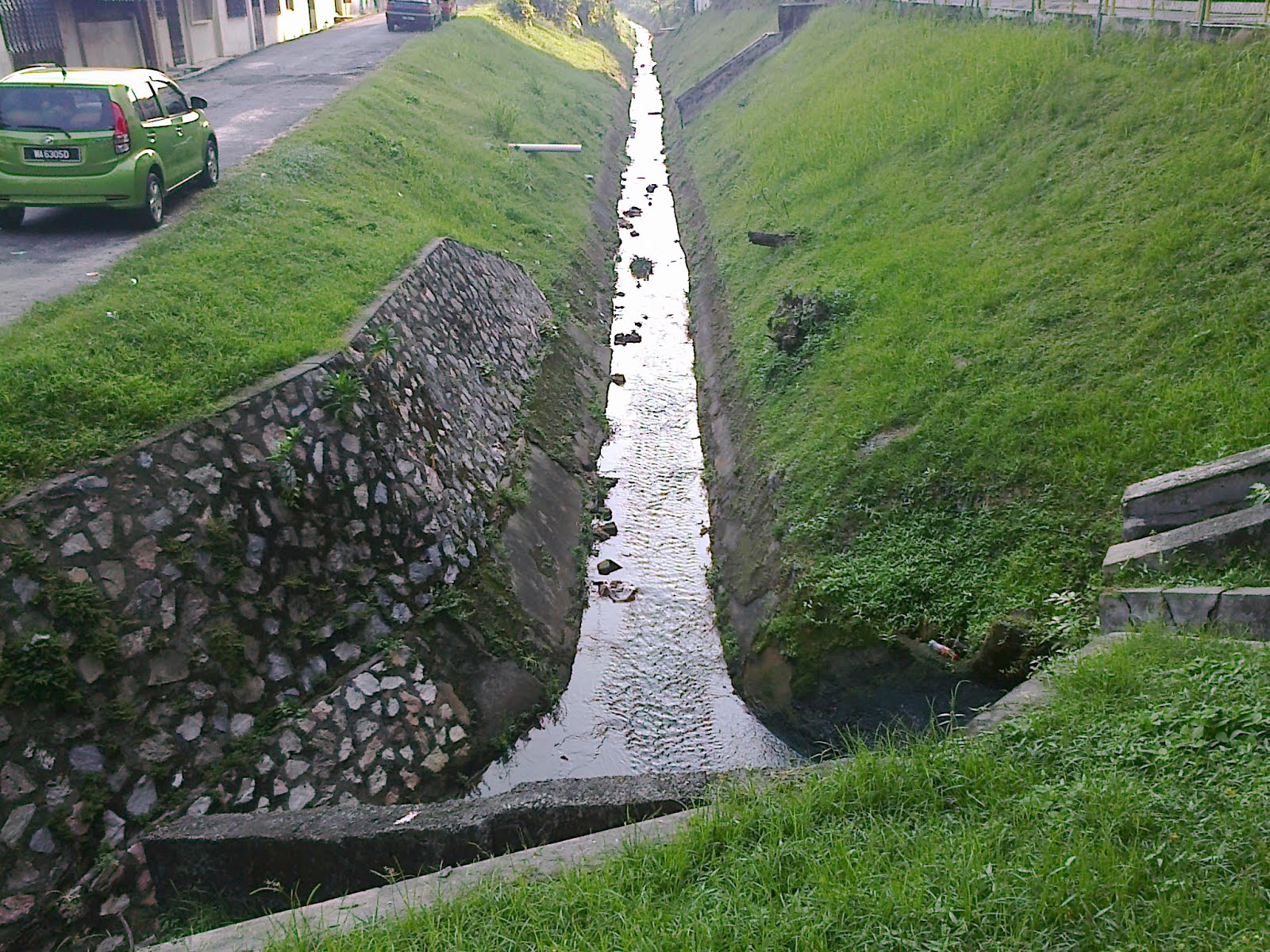
Well below is an example of a swale running behind the row of houses on Jalan 14/15, Section 14, Petaling Jaya.

Basically, a swale has a concrete drain at the bottom which carries the normal volume of drain water most of the time but when the water level is especially high, it overflows the concrete drain and the water seeps into the grass covered earth on either side. The idea of such storm drains is to slow the flow of water into the river so as to prevent flash floods.

Besides being more pleasing to the eye, the grass covered earth also does not retain heat, unlike concrete and if they planted some trees along the grassy part, it would not only be even more pleasing to the eye but would also help stabilise the soil and help reduce the heat. 


The rain just got heavier again.

Well, let's see what the traffic will be like on the main roads tomorrow (Friday 13 May 2016) morning.

Hmmm! Friday the 13th.

Charles F. Moreira


I CAN IMAGINE THE HORRENDOUS TRAFFIC JAM FRIDAY (TOMORROW) MORNING

With so many cars half submerged on the roads in the flash floods this Thurdsay 12 May 2016 evening, I do not expect that they will all be cleared from the roads by Friday morning when commuters are driving to work and these are arterial roads.

So I would not be surprised if there are horrendous traffic jams Friday morning.

I guess they could develop a mobile app or a cloud-based big data analytics app which will stop flash floods dead in their tracks (just being sarcastic).

Back in the 1960s Jalan Duta (Diplomatic Road), was built with the intention that embassies would re-locate there from the Jalan Ampang and Jalan U Thant area but most embassies stayed where they are.

Free Malaysia Today reports on the flash flood on Jalan Duta a major arterial road.

Jalan Duta hit by flash floods
FMT Reporters  | May 12, 2016
Other areas in city, like Bangsar and Kerinchi, also hit by flash floods.


banjir-duta

KUALA LUMPUR: A number of areas in the city experienced flash floods, with multiple cars and motorists stranded in the waist-high water this evening.

The Fire and Rescue Department, in a statement, said among the affected areas were Jalan Duta, heading to Damansara, and the entrance to University Malaya at Jalan Lingkungan Budi.

Around 100 vehicles were stuck in floodwaters along Jalan Duta and 15 vehicles at the entrance to Universiti Malaya.

Several fire trucks were seen at Kerinchi and Bangsar trying to help stranded motorists and reduce flooding.

Motorists took to Twitter to post pictures of the flooded streets.

“Happening now. Pls avoid Jalan Duta at all cost!” tweeted user William Lee.


“My friend posted this picture. Just 20 min ago at Jalan Duta. Avoid at all cost. Except if you have sampan. #kltu” tweeted user AbbyC.

“Standstill traffic on Jalan Duta. We haven’t moved in 10 minutes,” tweeted user Elza Irdalynna two hours ago.

http://www.freemalaysiatoday.com/category/nation/2016/05/12/jalan-duta-hit-by-flash-floods/

Charles F. Moreira


FROM SCORCHING HEAT WITHOUT RAIN TO FLASH FLOODS

It was scorching heat in Petaling Jaya and Kuala Lumpur about two to three weeks ago with temperatures hitting 37 degrees. with no rain for 10 days, the water level in dams approaching critical levels, with fears that we would have to suffer water rationing again - all due to the especially severe El Nino effect in the Pacific Ocean this year.

Then the rains came regularly in the evenings last week and this week and today, Thursday 12th May 2016, there are flash floods on roads in Kuala Lumpur, following a prolonged downpour which is still going right now.

As they say, "When it rains, it pours".

The Star reports:-


Over 100 vehicles trapped in Klang Valley flash floods - Nation | The Star Online

by tan yi liang Motorists stuck in the traffic after the flash floods in Jalan Tuanku Abdul Halim. - AZMAN GHANI / The Star

Motorists stuck in the traffic after the flash floods in Jalan Tuanku Abdul Halim. - AZMAN GHANI / The Star


PETALING JAYA: Flash floods hit several key roads in Kuala Lumpur causing vehicles to be trapped following a downpour on Thursday evening.   

In a series of photos posted on Twitter by Bernama, four roads were affected as of 8.48pm.  

The four roads are Jalan Pantai Bahru, Jalan Semantan, Jalan Bangsar and Jalan Pudu in front of the Tung Shin Hospital, according to photos taken from the Fire and Rescue Department.   

Additionally, in a media alert, the Fire and Rescue Department said that crews were dispatched to two locations in Kuala Lumpur after emergency calls were made by people trapped in the floods.  

It said that 20 firemen were sent at 7.26pm to a location in front of Duta Vista in Jalan Tuanku Abdul Halim where 100 vehicles were trapped along the road towards Damansara and Kuala Lumpur, forcing motorists to leave their vehicles.  

It added that another 13 Fire and Rescue Department personnel were sent to the Jalan Lingkungan Budi gate of Universiti Malaya at 7.58pm as 15 cars were stranded in flash floods and strong currents.   

"11 people were rescued including a woman who was having breathing difficulties," said the Fire and Rescue Department. 

The flash floods are not the first to hit the Klang Valley this week, with flooding reported in Shah Alam on Tuesday.   

According to Star Radio Traffic, the flash floods hit two locations along Persiaran Kayangan.   

The two spots were near the Concorde Hotel and the Darul Ehsan Aquatic Centre.

http://www.thestar.com.my/news/nation/2016/05/12/flash-floods-hit-klang-valley


Charles F. Moreira


03 May 2016

BEWARE YOU DON'T END UP AT THE BOTTOM OF A SEWER SHAFT

This report carried by Free Malaysia Today about a car plunging to a sewer shaft being built on Jalan Universiti, Petaling Jaya caught my eye today.

Apart from ending up in a shithole, fortunately nobody died. Also, thankfully, there's no shit in the shithole just yet but I wonder what will happen if one of the concrete shithole covers gives way some years later when a car or heavy lorry drives over it. By then, the shithole would be full of sewerage and the unfortunate passengers may well not get out alive.

I saw some people standing around the construction site of one of these sewer shafts on Jalan Universiti this evening but was not quite sure what it was all about as I was rushing to get some medicine for my aunt from a pharmacy before it closed.

Be especially careful when driving along roads such as Jalan Kemajuan in Petaling Jaya at night, since the street lights are all not working along this road and sewer construction is still ongoing along this road.

If this car could have plunged into this shithole whilst it was still light, what more the likelihood when it's dark.

This sewerage reticulation system being built in Petaling Jaya and elsewhere is a Federal Government project and the sewer shafts are dug into the roads, causing much traffic disruption.

Take care

Charles

Car plunges into 12m-deep sewer
FMT Reporters  | May 3, 2016
Firemen rescue two people inside who were badly hurt in the incident in Jalan Universiti, Petaling Jaya.


car

PETALING JAYA: Two people were hurt after their car plunged into a 12-metre-deep sewer under construction in Jalan Universiti, Section 17, today.

Damansara Rescue and Fire Department station chief Ramli Harun said they received a distress call at 2pm and sent a fire engine there, Star Online reported.

Firemen found a Toyota Vios had plunged into a sewer and managed to rescue the two inside after about an hour.

Both victims were sent to the Universiti Malaya Medical Centre for treatment for multiple injuries.

A crane was used to extricate the car from the sewer.

http://www.freemalaysiatoday.com/category/nation/2016/05/03/car-plunges-into-12m-deep-sewer/