Kuala Lumpur City Hall (DBKL) says it is willing to cooperate with other authorities to investigate any alleged corruption related to the recent flash floods;
Free Malaysia Today carries this BERNAMA report.
DBKL says tough to check for flash-flood corruption
May 15, 2016
City Hall ready to cooperate with MACC after Zahid calls for probe into mega projects.
KUALA LUMPUR: City Hall is prepared to cooperate with the Malaysian Anti-Corruption Commission to investigate allegations of corruption in development projects which have been blamed for the occurence of flash floods.
DBKL’s planning department executive director Mohd Najib Mohd said DBKL would also run its own checks “but I am not so sure of the outcome as the matter involves many parties and contractors, including the Drainage and Irrigation Department” he said.
Yesterday, Deputy Prime Minister Ahmad Zahid Hamidi had remarked that the government would investigate elements of corruption in development projects in the federal capital following the recent flash floods.
Mohd Najib said DBKL was still collecting information on existing infrastructure and efficient measures which could be taken to overcome flash flood issues in the city.
“For short-term measures, we will be improving communication between the operations room and our men on the ground, at least we will be in a state of full preparedness when facing the problem,” he said.
Mohd Najib said five locations had been identified as flood-prone hot spots: the areas around Jalan Duta, Bangsar, Bank Negara, Bukit Tunku and Cheras.
He said DBKL would hand over reports on the flash floods to Federal Territories Minister Tengku Adnan Mansor tomorrow and discuss the actions needed to be taken to resolve the matter.
– BERNAMA
http://www.freemalaysiatoday.com/category/nation/2016/05/15/dbkl-says-tough-to-check-for-corruption-by-itself/
16 May 2016

14 May 2016
SO WILL SEE AN END TO FLASH FLOODS IN THE KLANG VALLEY AFTER THIS?
It has been raining continuously in Petaling Jaya since 6 pm this Saturday 14th of May, somewhat like the continuous rain last Thursday evening which resulted in flash floods on major roads in Kuala Lumpur which I highlighted in my earlier blog posts on Thursday evening but there are no media reports of flooding today evening. Well, I guess it's a Saturday evening thing and reporters are off.
Anyway, below are three reports by BERNAMA - Malaysia's national news agency on statements by ministers and the Deputy Prime Minister on the causes of the flash floods and actions they recommend and propose.
Great statements and proposals for action by the Federal Government ministers but will these proposed actions solve these chronic and recurring problems of flash floods plaguing the Klang Valley?
BERNAMA reports on its own website on 12th May, the day when the flash floods referred to occurred in the evening:-
DBKL To Use Pipe Jacking System To Solve Flash Floods At 4 1/2 Mile Jln Klang Lama Market
KUALA LUMPUR, May 12 (Bernama) -- Kuala Lumpur City Hall (DBKL) has proposed the installation of underground pipes at the 4 1/2 Mile Jalan Klang Lama market to solve flash floods in the area.
DBKL Civil Engineering and Urban Transportation Department deputy director Sabudin Mohd Saleh said the pipe jacking process will start from the market to across the street, heading towards Sungai Klang to allow smooth flow of water.
"The flash floods occurred because the housing development project is situated too close to the market and the existing pipes cannot accommodate the storm runoff," he said when contacted by Bernama here today.
However, Sabudin said the proposal was still being discussed and detailed studies were needed before its implementation.
Meanwhile, DBKL advisory board member Datuk Wilson Lau Hoi Keong who visited the market today said some 100 traders were affected when the market was flooded on May 2.
Lau said following the visit, DBKL would hold a meeting with the traders, Pasar Batu 4 Jalan Klang Lama Hawker Association, concessionaire Alam Flora Sdn Bhd and the housing project developer to resolve problems.
-- BERNAMA
http://www.bernama.com.my/bernama/v8/ge/newsgeneral.php?id=1245126
On 13th May, Free Malaysia Today carried this BERNAMA report:-
May 13, 2016
Minister says drainage system for the Jalan Duta, Universiti Malaya and Bangsar areas needs to be upgraded by the authorities.

PUTRAJAYA: Natural Resources and Environment Minister Dr Wan Junaidi Tuanku Jaafar has attributed the cause of severe flash floods in Kuala Lumpur yesterday to an inefficient street drainage system.
He said that as a short-term measure, the drainage waterways would have to be deepened and maintenance of the system would have to be carried out more regularly.
“As a long-term measure, the drainage system for the Jalan Duta, Universiti Malaya and Bangsar areas will have to be upgraded by the authorities,” he told a press conference on the floods today.
The roads worst affected by the floods in Kuala Lumpur yesterday were Jalan Semantan, Jalan Tuanku Abdul Halim (Jalan Duta), Jalan Bangsar, Jalan Pudu and Jalan Pantai Baharu.
Wan Junaidi said he did not rule out the possibility that the flash floods in Jalan Duta were caused by the construction of the Mass Rapid Transit (MRT) in the area.
“I may speak to them,” he said when asked whether he would discuss the matter with the MRT authorities.
He said the Department of Irrigation and Drainage had prepared an environmentally friendly drainage master plan and detailed design in accordance with the Environmentally Friendly Drainage Manual for submission to the state governments and local authorities as construction and maintenance of street drainage systems came under their jurisdiction.
Wan Junaidi advised the people against throwing refuse into the drainage systems and rivers so as to reduce the risk of flash floods and to enable the systems to function at full capacity.
– BERNAMA
http://www.freemalaysiatoday.com/category/nation/2016/05/13/inefficient-street-drainage-cause-of-kl-flash-floods/
Also on 13th May, Free Malaysia Today carred ins BERNAMA report about the statement by Klang Valley Mass Rapid Transit project implementation partner MMC-Gamuda rebutting allegations that its construction works were responsible for the flash floods.
May 13, 2016
Company says work now relates to tracks and signalling, ground activities are complete with permanent drainage that is well-maintained.

KUALA LUMPUR: MMC Gamuda KVMRT (PDP) Sdn Bhd, the project delivery partner of the Mass Rapid Transit (MRT), clarified that the flash flood that occurred near Jalan Duta yesterday evening was not related to the MRT construction.
MMC Gamuda KVMRT (PDP), in a statement today, said based on the investigations conducted, the incident was not caused by nor related to the construction of the MRT Sungai Buloh-Kajang (SBK) line.
“The current construction activities at MRT Jalan Duta worksite are carried out on the MRT elevated viaduct, such as the train and the signaling works.
“The ground activities, such as civil works and permanent drainage, have been completed and continuously well-maintained,” the statement said.
MMC Gamuda KVMRT (PDP) said it would continue to work hand-in-hand with its Work Package Contractors to provide support to the public along the SBK MRT alignment during this rainy season.
– BERNAMA
http://www.freemalaysiatoday.com/category/nation/2016/05/13/mrt-project-didnt-cause-flash-floods-says-mmc-gamuda/
And today, 14th May 2016, Free Malaysia Today carried this BERNAMA report:-
May 14, 2016
Zahid: those accusing each other to be ordered to work together to find best solution.

KUALA LUMPUR: The government will investigate possible elements of corruption in development projects in the federal capital, especially those involving mega projects, which might have triggered the recent flash floods.
Deputy Prime Minister Ahmad Zahid Hamidi said the authorities responsible would be asked to conduct investigations and provide full reports on the incident to enable follow-up actions to be taken.
Ahmad Zahid, who is also the chairman of the Cabinet Committee on Disasters, said parties accusing each other of the problem would be ordered to sit down and find the best solution to tackle the issue.
“The best is to resolve the people’s problem in both the short and long term so that it would not recur. There should be no flash floods in Kuala Lumpur as the system and infrastructure for flood management were good.
“Maybe there is a problem with draining water from excessive rain…I will assist the ministries and departments concerned to resolve the problem,” he said.
– BERNAMA
http://www.freemalaysiatoday.com/category/nation/2016/05/14/flash-floods-probe-into-corruption-in-mega-projects/
Anyway, below are three reports by BERNAMA - Malaysia's national news agency on statements by ministers and the Deputy Prime Minister on the causes of the flash floods and actions they recommend and propose.
Great statements and proposals for action by the Federal Government ministers but will these proposed actions solve these chronic and recurring problems of flash floods plaguing the Klang Valley?
BERNAMA reports on its own website on 12th May, the day when the flash floods referred to occurred in the evening:-
DBKL To Use Pipe Jacking System To Solve Flash Floods At 4 1/2 Mile Jln Klang Lama Market
KUALA LUMPUR, May 12 (Bernama) -- Kuala Lumpur City Hall (DBKL) has proposed the installation of underground pipes at the 4 1/2 Mile Jalan Klang Lama market to solve flash floods in the area.
DBKL Civil Engineering and Urban Transportation Department deputy director Sabudin Mohd Saleh said the pipe jacking process will start from the market to across the street, heading towards Sungai Klang to allow smooth flow of water.
"The flash floods occurred because the housing development project is situated too close to the market and the existing pipes cannot accommodate the storm runoff," he said when contacted by Bernama here today.
However, Sabudin said the proposal was still being discussed and detailed studies were needed before its implementation.
Meanwhile, DBKL advisory board member Datuk Wilson Lau Hoi Keong who visited the market today said some 100 traders were affected when the market was flooded on May 2.
Lau said following the visit, DBKL would hold a meeting with the traders, Pasar Batu 4 Jalan Klang Lama Hawker Association, concessionaire Alam Flora Sdn Bhd and the housing project developer to resolve problems.
-- BERNAMA
http://www.bernama.com.my/bernama/v8/ge/newsgeneral.php?id=1245126
On 13th May, Free Malaysia Today carried this BERNAMA report:-
Inefficient street drainage cause of KL flash floods
May 13, 2016
Minister says drainage system for the Jalan Duta, Universiti Malaya and Bangsar areas needs to be upgraded by the authorities.

PUTRAJAYA: Natural Resources and Environment Minister Dr Wan Junaidi Tuanku Jaafar has attributed the cause of severe flash floods in Kuala Lumpur yesterday to an inefficient street drainage system.
He said that as a short-term measure, the drainage waterways would have to be deepened and maintenance of the system would have to be carried out more regularly.
“As a long-term measure, the drainage system for the Jalan Duta, Universiti Malaya and Bangsar areas will have to be upgraded by the authorities,” he told a press conference on the floods today.
The roads worst affected by the floods in Kuala Lumpur yesterday were Jalan Semantan, Jalan Tuanku Abdul Halim (Jalan Duta), Jalan Bangsar, Jalan Pudu and Jalan Pantai Baharu.
Wan Junaidi said he did not rule out the possibility that the flash floods in Jalan Duta were caused by the construction of the Mass Rapid Transit (MRT) in the area.
“I may speak to them,” he said when asked whether he would discuss the matter with the MRT authorities.
He said the Department of Irrigation and Drainage had prepared an environmentally friendly drainage master plan and detailed design in accordance with the Environmentally Friendly Drainage Manual for submission to the state governments and local authorities as construction and maintenance of street drainage systems came under their jurisdiction.
Wan Junaidi advised the people against throwing refuse into the drainage systems and rivers so as to reduce the risk of flash floods and to enable the systems to function at full capacity.
– BERNAMA
http://www.freemalaysiatoday.com/category/nation/2016/05/13/inefficient-street-drainage-cause-of-kl-flash-floods/
Also on 13th May, Free Malaysia Today carred ins BERNAMA report about the statement by Klang Valley Mass Rapid Transit project implementation partner MMC-Gamuda rebutting allegations that its construction works were responsible for the flash floods.
MRT project didn't cause flash floods, says MMC Gamuda
May 13, 2016
Company says work now relates to tracks and signalling, ground activities are complete with permanent drainage that is well-maintained.
KUALA LUMPUR: MMC Gamuda KVMRT (PDP) Sdn Bhd, the project delivery partner of the Mass Rapid Transit (MRT), clarified that the flash flood that occurred near Jalan Duta yesterday evening was not related to the MRT construction.
MMC Gamuda KVMRT (PDP), in a statement today, said based on the investigations conducted, the incident was not caused by nor related to the construction of the MRT Sungai Buloh-Kajang (SBK) line.
“The current construction activities at MRT Jalan Duta worksite are carried out on the MRT elevated viaduct, such as the train and the signaling works.
“The ground activities, such as civil works and permanent drainage, have been completed and continuously well-maintained,” the statement said.
MMC Gamuda KVMRT (PDP) said it would continue to work hand-in-hand with its Work Package Contractors to provide support to the public along the SBK MRT alignment during this rainy season.
– BERNAMA
And today, 14th May 2016, Free Malaysia Today carried this BERNAMA report:-
Flash floods: Probe into corruption in mega-projects
May 14, 2016
Zahid: those accusing each other to be ordered to work together to find best solution.

KUALA LUMPUR: The government will investigate possible elements of corruption in development projects in the federal capital, especially those involving mega projects, which might have triggered the recent flash floods.
Deputy Prime Minister Ahmad Zahid Hamidi said the authorities responsible would be asked to conduct investigations and provide full reports on the incident to enable follow-up actions to be taken.
Ahmad Zahid, who is also the chairman of the Cabinet Committee on Disasters, said parties accusing each other of the problem would be ordered to sit down and find the best solution to tackle the issue.
“The best is to resolve the people’s problem in both the short and long term so that it would not recur. There should be no flash floods in Kuala Lumpur as the system and infrastructure for flood management were good.
“Maybe there is a problem with draining water from excessive rain…I will assist the ministries and departments concerned to resolve the problem,” he said.
– BERNAMA
http://www.freemalaysiatoday.com/category/nation/2016/05/14/flash-floods-probe-into-corruption-in-mega-projects/
13 May 2016
EYEWITNESS ACCOUNT FROM DAVID FOO
In response to my posts below, Section 12, Petaling Jaya residents and environmental activist David Foo provides an eye-witness account of water on roads in the Bangsar area of Kuala Lumpur, about two kilometres from the border with Petaling Jaya.
Last Saturday evening - about 6.30pm - I took the internal roads of Bangsar to get from Jalan Riong to Jalan Pantai Baru. It was pouring cats and dogs then, and I witnessed an amazing sight - waterfalls along the roads like Jalan Riong, Jalan Tanduk, Jalan Kurau, Jalan Bilis and Jalan Tempinis Kanan. Water was springing out of drains like up-side-down waterfalls. Evidently, the drainage is not competent to handle such voluminous downpours - having been designed more than half a century ago, long before massive developments sprung up in the upper reaches of the neighbourhood.
MBPJ's (Petaling Jaya City Council's) crowning glory - that retention or detention pond between Jalan 12/12 and 12/14, fills up like your beer glass being filled up with supply from a fire hose reel. At this point in time, a lot more planned and approved concrete which will augment the surface run off feeding this pseudo-reservoir, is yet to be mixed and poured. Houses on Jalan 12/14, more than 3 meters above the brim of this water channel, are still flooding.
This highlights MBPJ's typical sight on the big picture frame. They splash paint on it with idea of what image will form and fail to look at the pixels which form the lines. Yes, they have monstrous drains and littler ones to feed them, but, hey, the gullets of the minor siblings are choked and remain choked. And so we see water regurgitating like a food poisoning victim puking.
sigh... perhaps I could do a much better job than those paid jesters. No, not perhaps. I am confident.
And
Jalan Duta is the SIN of monorail works, while the area surrounding Universiti Malaya's KL gate is possibly fed by Bangsar South and the newbies of original Bangsar.
"Monorail" or Mass Rapid Transit?
Anyway, a large, concrete lined storm retention drain runs behind David's home in Section 12 Petaling Jaya and he has been hammering away at the Petaling Jaya City Council that they should have made it a swale, instead of an all concrete lined storm retention drain.
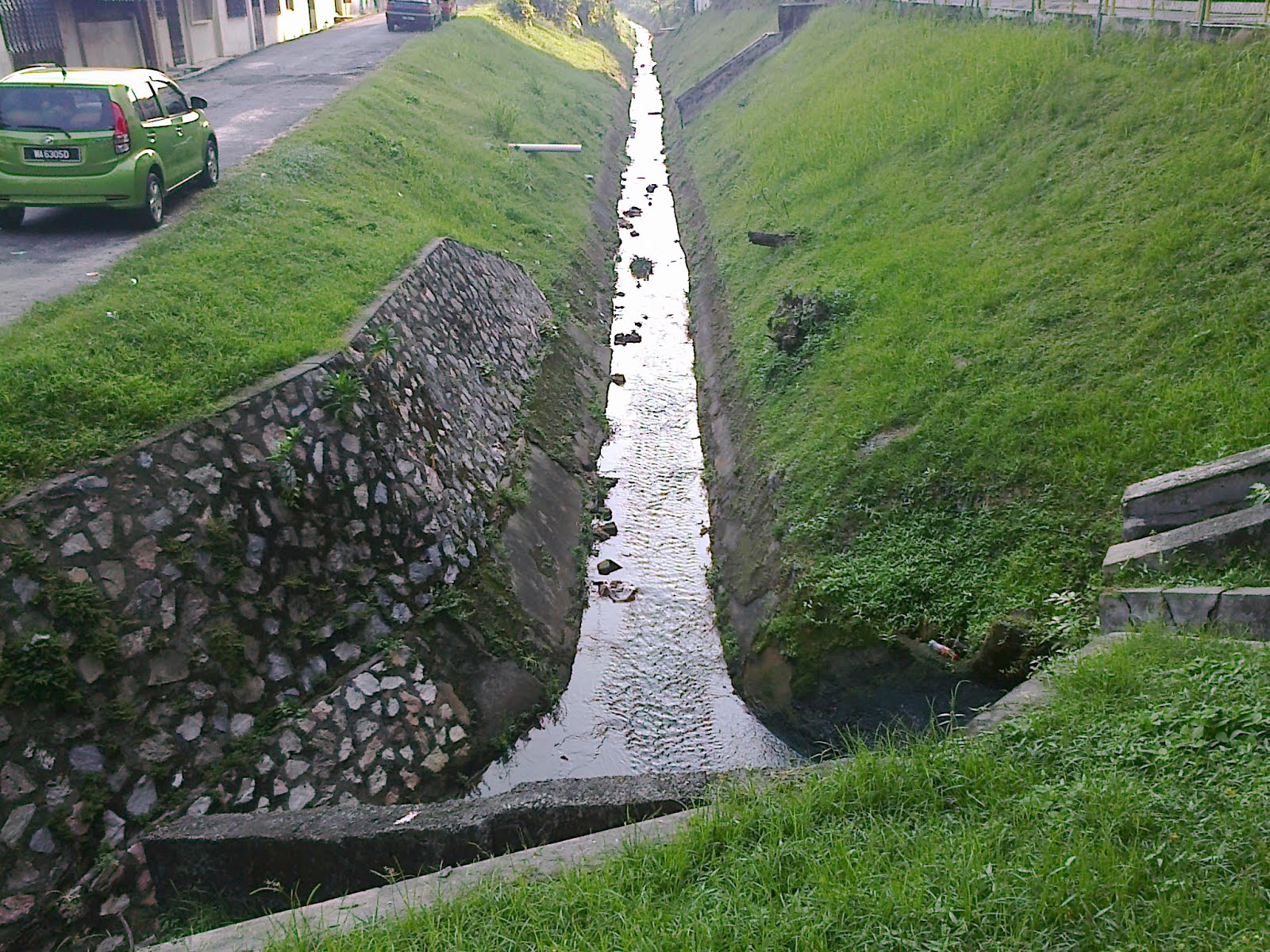
What's a swale?
Well below is an example of a swale running behind the row of houses on Jalan 14/15, Section 14, Petaling Jaya.
Basically, a swale has a concrete drain at the bottom which carries the normal volume of drain water most of the time but when the water level is especially high, it overflows the concrete drain and the water seeps into the grass covered earth on either side. The idea of such storm drains is to slow the flow of water into the river so as to prevent flash floods.
Besides being more pleasing to the eye, the grass covered earth also does not retain heat, unlike concrete and if they planted some trees along the grassy part, it would not only be even more pleasing to the eye but would also help stabilise the soil and help reduce the heat.

The rain just got heavier again.
Well, let's see what the traffic will be like on the main roads tomorrow (Friday 13 May 2016) morning.
Hmmm! Friday the 13th.
Charles F. Moreira
Last Saturday evening - about 6.30pm - I took the internal roads of Bangsar to get from Jalan Riong to Jalan Pantai Baru. It was pouring cats and dogs then, and I witnessed an amazing sight - waterfalls along the roads like Jalan Riong, Jalan Tanduk, Jalan Kurau, Jalan Bilis and Jalan Tempinis Kanan. Water was springing out of drains like up-side-down waterfalls. Evidently, the drainage is not competent to handle such voluminous downpours - having been designed more than half a century ago, long before massive developments sprung up in the upper reaches of the neighbourhood.
MBPJ's (Petaling Jaya City Council's) crowning glory - that retention or detention pond between Jalan 12/12 and 12/14, fills up like your beer glass being filled up with supply from a fire hose reel. At this point in time, a lot more planned and approved concrete which will augment the surface run off feeding this pseudo-reservoir, is yet to be mixed and poured. Houses on Jalan 12/14, more than 3 meters above the brim of this water channel, are still flooding.
This highlights MBPJ's typical sight on the big picture frame. They splash paint on it with idea of what image will form and fail to look at the pixels which form the lines. Yes, they have monstrous drains and littler ones to feed them, but, hey, the gullets of the minor siblings are choked and remain choked. And so we see water regurgitating like a food poisoning victim puking.
sigh... perhaps I could do a much better job than those paid jesters. No, not perhaps. I am confident.
And
Jalan Duta is the SIN of monorail works, while the area surrounding Universiti Malaya's KL gate is possibly fed by Bangsar South and the newbies of original Bangsar.
"Monorail" or Mass Rapid Transit?
Anyway, a large, concrete lined storm retention drain runs behind David's home in Section 12 Petaling Jaya and he has been hammering away at the Petaling Jaya City Council that they should have made it a swale, instead of an all concrete lined storm retention drain.
What's a swale?
Well below is an example of a swale running behind the row of houses on Jalan 14/15, Section 14, Petaling Jaya.
Basically, a swale has a concrete drain at the bottom which carries the normal volume of drain water most of the time but when the water level is especially high, it overflows the concrete drain and the water seeps into the grass covered earth on either side. The idea of such storm drains is to slow the flow of water into the river so as to prevent flash floods.
Besides being more pleasing to the eye, the grass covered earth also does not retain heat, unlike concrete and if they planted some trees along the grassy part, it would not only be even more pleasing to the eye but would also help stabilise the soil and help reduce the heat.
The rain just got heavier again.
Well, let's see what the traffic will be like on the main roads tomorrow (Friday 13 May 2016) morning.
Hmmm! Friday the 13th.
Charles F. Moreira
I CAN IMAGINE THE HORRENDOUS TRAFFIC JAM FRIDAY (TOMORROW) MORNING
With so many cars half submerged on the roads in the flash floods this Thurdsay 12 May 2016 evening, I do not expect that they will all be cleared from the roads by Friday morning when commuters are driving to work and these are arterial roads.
So I would not be surprised if there are horrendous traffic jams Friday morning.
I guess they could develop a mobile app or a cloud-based big data analytics app which will stop flash floods dead in their tracks (just being sarcastic).
Back in the 1960s Jalan Duta (Diplomatic Road), was built with the intention that embassies would re-locate there from the Jalan Ampang and Jalan U Thant area but most embassies stayed where they are.
Free Malaysia Today reports on the flash flood on Jalan Duta a major arterial road.
Jalan Duta hit by flash floods
FMT Reporters | May 12, 2016
Other areas in city, like Bangsar and Kerinchi, also hit by flash floods.

KUALA LUMPUR: A number of areas in the city experienced flash floods, with multiple cars and motorists stranded in the waist-high water this evening.
The Fire and Rescue Department, in a statement, said among the affected areas were Jalan Duta, heading to Damansara, and the entrance to University Malaya at Jalan Lingkungan Budi.
Around 100 vehicles were stuck in floodwaters along Jalan Duta and 15 vehicles at the entrance to Universiti Malaya.
Several fire trucks were seen at Kerinchi and Bangsar trying to help stranded motorists and reduce flooding.
Motorists took to Twitter to post pictures of the flooded streets.
“Happening now. Pls avoid Jalan Duta at all cost!” tweeted user William Lee.
“My friend posted this picture. Just 20 min ago at Jalan Duta. Avoid at all cost. Except if you have sampan. #kltu” tweeted user AbbyC.
“Standstill traffic on Jalan Duta. We haven’t moved in 10 minutes,” tweeted user Elza Irdalynna two hours ago.
http://www.freemalaysiatoday.com/category/nation/2016/05/12/jalan-duta-hit-by-flash-floods/
Charles F. Moreira
So I would not be surprised if there are horrendous traffic jams Friday morning.
I guess they could develop a mobile app or a cloud-based big data analytics app which will stop flash floods dead in their tracks (just being sarcastic).
Back in the 1960s Jalan Duta (Diplomatic Road), was built with the intention that embassies would re-locate there from the Jalan Ampang and Jalan U Thant area but most embassies stayed where they are.
Free Malaysia Today reports on the flash flood on Jalan Duta a major arterial road.
Jalan Duta hit by flash floods
FMT Reporters | May 12, 2016
Other areas in city, like Bangsar and Kerinchi, also hit by flash floods.

KUALA LUMPUR: A number of areas in the city experienced flash floods, with multiple cars and motorists stranded in the waist-high water this evening.
The Fire and Rescue Department, in a statement, said among the affected areas were Jalan Duta, heading to Damansara, and the entrance to University Malaya at Jalan Lingkungan Budi.
Around 100 vehicles were stuck in floodwaters along Jalan Duta and 15 vehicles at the entrance to Universiti Malaya.
Several fire trucks were seen at Kerinchi and Bangsar trying to help stranded motorists and reduce flooding.
Motorists took to Twitter to post pictures of the flooded streets.
“Happening now. Pls avoid Jalan Duta at all cost!” tweeted user William Lee.
“My friend posted this picture. Just 20 min ago at Jalan Duta. Avoid at all cost. Except if you have sampan. #kltu” tweeted user AbbyC.
“Standstill traffic on Jalan Duta. We haven’t moved in 10 minutes,” tweeted user Elza Irdalynna two hours ago.
http://www.freemalaysiatoday.com/category/nation/2016/05/12/jalan-duta-hit-by-flash-floods/
Charles F. Moreira
FROM SCORCHING HEAT WITHOUT RAIN TO FLASH FLOODS
It was scorching heat in Petaling Jaya and Kuala Lumpur about two to three weeks ago with temperatures hitting 37 degrees. with no rain for 10 days, the water level in dams approaching critical levels, with fears that we would have to suffer water rationing again - all due to the especially severe El Nino effect in the Pacific Ocean this year.
Then the rains came regularly in the evenings last week and this week and today, Thursday 12th May 2016, there are flash floods on roads in Kuala Lumpur, following a prolonged downpour which is still going right now.
As they say, "When it rains, it pours".
The Star reports:-

Motorists stuck in the traffic after the flash floods in Jalan Tuanku Abdul Halim. - AZMAN GHANI / The Star
PETALING JAYA: Flash floods hit several key roads in Kuala Lumpur causing vehicles to be trapped following a downpour on Thursday evening.
In a series of photos posted on Twitter by Bernama, four roads were affected as of 8.48pm.
The four roads are Jalan Pantai Bahru, Jalan Semantan, Jalan Bangsar and Jalan Pudu in front of the Tung Shin Hospital, according to photos taken from the Fire and Rescue Department.
Additionally, in a media alert, the Fire and Rescue Department said that crews were dispatched to two locations in Kuala Lumpur after emergency calls were made by people trapped in the floods.
It said that 20 firemen were sent at 7.26pm to a location in front of Duta Vista in Jalan Tuanku Abdul Halim where 100 vehicles were trapped along the road towards Damansara and Kuala Lumpur, forcing motorists to leave their vehicles.
It added that another 13 Fire and Rescue Department personnel were sent to the Jalan Lingkungan Budi gate of Universiti Malaya at 7.58pm as 15 cars were stranded in flash floods and strong currents.
"11 people were rescued including a woman who was having breathing difficulties," said the Fire and Rescue Department.
The flash floods are not the first to hit the Klang Valley this week, with flooding reported in Shah Alam on Tuesday.
According to Star Radio Traffic, the flash floods hit two locations along Persiaran Kayangan.
The two spots were near the Concorde Hotel and the Darul Ehsan Aquatic Centre.
Charles F. Moreira
Then the rains came regularly in the evenings last week and this week and today, Thursday 12th May 2016, there are flash floods on roads in Kuala Lumpur, following a prolonged downpour which is still going right now.
As they say, "When it rains, it pours".
The Star reports:-
Over 100 vehicles trapped in Klang Valley flash floods - Nation | The Star Online
by tan yi liangMotorists stuck in the traffic after the flash floods in Jalan Tuanku Abdul Halim. - AZMAN GHANI / The Star
PETALING JAYA: Flash floods hit several key roads in Kuala Lumpur causing vehicles to be trapped following a downpour on Thursday evening.
In a series of photos posted on Twitter by Bernama, four roads were affected as of 8.48pm.
The four roads are Jalan Pantai Bahru, Jalan Semantan, Jalan Bangsar and Jalan Pudu in front of the Tung Shin Hospital, according to photos taken from the Fire and Rescue Department.
Additionally, in a media alert, the Fire and Rescue Department said that crews were dispatched to two locations in Kuala Lumpur after emergency calls were made by people trapped in the floods.
It said that 20 firemen were sent at 7.26pm to a location in front of Duta Vista in Jalan Tuanku Abdul Halim where 100 vehicles were trapped along the road towards Damansara and Kuala Lumpur, forcing motorists to leave their vehicles.
It added that another 13 Fire and Rescue Department personnel were sent to the Jalan Lingkungan Budi gate of Universiti Malaya at 7.58pm as 15 cars were stranded in flash floods and strong currents.
"11 people were rescued including a woman who was having breathing difficulties," said the Fire and Rescue Department.
The flash floods are not the first to hit the Klang Valley this week, with flooding reported in Shah Alam on Tuesday.
According to Star Radio Traffic, the flash floods hit two locations along Persiaran Kayangan.
The two spots were near the Concorde Hotel and the Darul Ehsan Aquatic Centre.
http://www.thestar.com.my/news/nation/2016/05/12/flash-floods-hit-klang-valley
Charles F. Moreira
03 May 2016
BEWARE YOU DON'T END UP AT THE BOTTOM OF A SEWER SHAFT
This report carried by Free Malaysia Today about a car plunging to a sewer shaft being built on Jalan Universiti, Petaling Jaya caught my eye today.
Apart from ending up in a shithole, fortunately nobody died. Also, thankfully, there's no shit in the shithole just yet but I wonder what will happen if one of the concrete shithole covers gives way some years later when a car or heavy lorry drives over it. By then, the shithole would be full of sewerage and the unfortunate passengers may well not get out alive.
I saw some people standing around the construction site of one of these sewer shafts on Jalan Universiti this evening but was not quite sure what it was all about as I was rushing to get some medicine for my aunt from a pharmacy before it closed.
Be especially careful when driving along roads such as Jalan Kemajuan in Petaling Jaya at night, since the street lights are all not working along this road and sewer construction is still ongoing along this road.
If this car could have plunged into this shithole whilst it was still light, what more the likelihood when it's dark.
This sewerage reticulation system being built in Petaling Jaya and elsewhere is a Federal Government project and the sewer shafts are dug into the roads, causing much traffic disruption.
Take care
Charles
Car plunges into 12m-deep sewer
FMT Reporters | May 3, 2016
Firemen rescue two people inside who were badly hurt in the incident in Jalan Universiti, Petaling Jaya.

PETALING JAYA: Two people were hurt after their car plunged into a 12-metre-deep sewer under construction in Jalan Universiti, Section 17, today.
Damansara Rescue and Fire Department station chief Ramli Harun said they received a distress call at 2pm and sent a fire engine there, Star Online reported.
Firemen found a Toyota Vios had plunged into a sewer and managed to rescue the two inside after about an hour.
Both victims were sent to the Universiti Malaya Medical Centre for treatment for multiple injuries.
A crane was used to extricate the car from the sewer.
http://www.freemalaysiatoday.com/category/nation/2016/05/03/car-plunges-into-12m-deep-sewer/
Apart from ending up in a shithole, fortunately nobody died. Also, thankfully, there's no shit in the shithole just yet but I wonder what will happen if one of the concrete shithole covers gives way some years later when a car or heavy lorry drives over it. By then, the shithole would be full of sewerage and the unfortunate passengers may well not get out alive.
I saw some people standing around the construction site of one of these sewer shafts on Jalan Universiti this evening but was not quite sure what it was all about as I was rushing to get some medicine for my aunt from a pharmacy before it closed.
Be especially careful when driving along roads such as Jalan Kemajuan in Petaling Jaya at night, since the street lights are all not working along this road and sewer construction is still ongoing along this road.
If this car could have plunged into this shithole whilst it was still light, what more the likelihood when it's dark.
This sewerage reticulation system being built in Petaling Jaya and elsewhere is a Federal Government project and the sewer shafts are dug into the roads, causing much traffic disruption.
Take care
Charles
Car plunges into 12m-deep sewer
FMT Reporters | May 3, 2016
Firemen rescue two people inside who were badly hurt in the incident in Jalan Universiti, Petaling Jaya.

PETALING JAYA: Two people were hurt after their car plunged into a 12-metre-deep sewer under construction in Jalan Universiti, Section 17, today.
Damansara Rescue and Fire Department station chief Ramli Harun said they received a distress call at 2pm and sent a fire engine there, Star Online reported.
Firemen found a Toyota Vios had plunged into a sewer and managed to rescue the two inside after about an hour.
Both victims were sent to the Universiti Malaya Medical Centre for treatment for multiple injuries.
A crane was used to extricate the car from the sewer.
http://www.freemalaysiatoday.com/category/nation/2016/05/03/car-plunges-into-12m-deep-sewer/
20 April 2016
HOW TO KNOW IF YOUR INFRA-RED REMOTE CONTROL IS WORKING!
Your TV, air conditioner, fan or stereo system is not responding to presses of your remote control. You replace the batteries in your infra-red remote control but it makes no difference. So how to know if the problem is with the remote control or the appliance you are trying to remotely control with it, especially when our eyes cannot see infra-red light?
Try it, just press a button on your remote control whilst looking at the infra-red LED and see if you can see it flashing.
Not to get too technical, infra-red light comprises of frequencies lower than the red end of the visible spectrum or that very narrow range of frequencies of electromagnetic waves which our eyes can see - i.e. frequencies ranging from 405 THz to 790 THz (Terahertz). Above 790 THz is ultra violet (UV) light which our eyes cannot see either.
Anyway, I learned how to see the infra-red LED flashing last Wednesday - i.e. 13th of April 2016, when I took my aunt's suspected faulty TV remote control into the Philips service centre on Jalan Kilang, Petaling Jaya.
I asked the customer service person whether he could test the remote out with a TV but instead he took out his smartphone and viewed the remote through its display screen and said "it's not working". He then did the same with the replacement remote for which Philips charged RM50 and confirmed that it is working.
"Are you running any special application on your phone", I asked and he replied, "No. I just viewed it through the phone's camera. It works with most phones, your's too, except for the iPhone 6". So I took out my Nokia, turned on the camera, held the replacement remote below it, pressed a button on the remote and low and behold, I saw the infra-red LED blinking.
CLICK HERE TO SEE INFRA-RED LED BLINKING
"Why doesn't it work with the iPhone 6", I asked and he replied, "Well, it of more sophisticated".
He then advised me not to use expensive alkaline cells with the remote but instead regular use cheaper heavy duty zinc-manganese cells.
Much earlier, I had been given similar advice with regards digital clocks and according to Michael Bluejay's Battery Guide, digital clocks and remote controls draw low current from the battery.
http://michaelbluejay.com/batteries/
So I paid him the RM50, he gave me the receipt, I thanked him and since this replacement remote control, even from Philips, comes with no warranty but though I could return it for a free exchange within the same day, if it was not working, so I rushed off to my aunt's place that very morning to test it with her TV and yes it worked fine - Yippiee! So I left it there.
When I got home, I tried viewing the infra-red LEDs of several remote controls in my home through my phone's camera and yes, I could see them blinking. Whilst I have not tried it with a dedicated digital camera, perhaps you may want to experiment.
Now why cannot a iPhone 6 be used to view a blinking infra-red LED. What did he mean by this model being "more sophisticated".
Well, I don't have an iPhone 6 to verify his claim but it makes sense that if a camera is to produce a picture which faithfully reproduce what our eyes see, then the camera's visible spectrum must as closely as possible match our eyes' visible spectrum, otherwise pictures it takes will contain more than our eyes actually see, so I guess that being "more sophisticated", as this customer service person described, the range of an iPhone 6 camera's photo sensor closely matches our visible spectrum or its processing circuitry more tightly filters out frequencies outside our visible spectrum.
Once again, I've not had the opportunity to try this out but anyone with an iPhone 6 is welcome to try out for themselves.
"Now what actually happened to the remote?" you wonder.
Well my aunt accidentally spilled some wine onto the remote which was on the same side table and she immediately shook off any excess wine on the remote and wiped it clean and since it continued to work for a whole afterwards, she thought that all was OK with the remote until it later died on her.
Now in such situations, with a remote control, mobile phone, digital camera or any other battery powered device, remove the batteries as soon to avoid the short circuiting of any delicate electronics within.
After removing the batteries, SIM and any memory cards as in the case of a mobile phone, try and dismantle the device as best you can, such as remove the front and back covers if possible.
Then rinse the remote or phone in clean water, shaking it in the water to ensure that any acids, salts, alkalis or whatever in the fluid which has got into the device is washed out.
Shake the device vigourously to expel as much water inside as you can, then suck out whatever remaining water with a powerful vacuum cleaner.
Then leave the device standing upright ideally for a day, two or even three days in a warm and dry place so than any moisture left in it will evaporate.
Once you are satisfied that it has properly dried out, re-assemble the device, put in the batteries and test it out.
I first brought my aunt's remote home and cleaned it up as described but it appears that it was too late and the wine with the acids and other substances it contains had resulted in the remote's electronics shorting out which killed it.
Meanwhile, why not have some fun viewing the blinking infra-red LED on your remote control through your digital camera's of phone camera's viewfinder.
Cheers
Charles F. Moreira
Try it, just press a button on your remote control whilst looking at the infra-red LED and see if you can see it flashing.
Not to get too technical, infra-red light comprises of frequencies lower than the red end of the visible spectrum or that very narrow range of frequencies of electromagnetic waves which our eyes can see - i.e. frequencies ranging from 405 THz to 790 THz (Terahertz). Above 790 THz is ultra violet (UV) light which our eyes cannot see either.
Anyway, I learned how to see the infra-red LED flashing last Wednesday - i.e. 13th of April 2016, when I took my aunt's suspected faulty TV remote control into the Philips service centre on Jalan Kilang, Petaling Jaya.
I asked the customer service person whether he could test the remote out with a TV but instead he took out his smartphone and viewed the remote through its display screen and said "it's not working". He then did the same with the replacement remote for which Philips charged RM50 and confirmed that it is working.
"Are you running any special application on your phone", I asked and he replied, "No. I just viewed it through the phone's camera. It works with most phones, your's too, except for the iPhone 6". So I took out my Nokia, turned on the camera, held the replacement remote below it, pressed a button on the remote and low and behold, I saw the infra-red LED blinking.
CLICK HERE TO SEE INFRA-RED LED BLINKING
"Why doesn't it work with the iPhone 6", I asked and he replied, "Well, it of more sophisticated".
He then advised me not to use expensive alkaline cells with the remote but instead regular use cheaper heavy duty zinc-manganese cells.
Much earlier, I had been given similar advice with regards digital clocks and according to Michael Bluejay's Battery Guide, digital clocks and remote controls draw low current from the battery.
http://michaelbluejay.com/batteries/
So I paid him the RM50, he gave me the receipt, I thanked him and since this replacement remote control, even from Philips, comes with no warranty but though I could return it for a free exchange within the same day, if it was not working, so I rushed off to my aunt's place that very morning to test it with her TV and yes it worked fine - Yippiee! So I left it there.
When I got home, I tried viewing the infra-red LEDs of several remote controls in my home through my phone's camera and yes, I could see them blinking. Whilst I have not tried it with a dedicated digital camera, perhaps you may want to experiment.
Now why cannot a iPhone 6 be used to view a blinking infra-red LED. What did he mean by this model being "more sophisticated".
Well, I don't have an iPhone 6 to verify his claim but it makes sense that if a camera is to produce a picture which faithfully reproduce what our eyes see, then the camera's visible spectrum must as closely as possible match our eyes' visible spectrum, otherwise pictures it takes will contain more than our eyes actually see, so I guess that being "more sophisticated", as this customer service person described, the range of an iPhone 6 camera's photo sensor closely matches our visible spectrum or its processing circuitry more tightly filters out frequencies outside our visible spectrum.
Once again, I've not had the opportunity to try this out but anyone with an iPhone 6 is welcome to try out for themselves.
"Now what actually happened to the remote?" you wonder.
Well my aunt accidentally spilled some wine onto the remote which was on the same side table and she immediately shook off any excess wine on the remote and wiped it clean and since it continued to work for a whole afterwards, she thought that all was OK with the remote until it later died on her.
Now in such situations, with a remote control, mobile phone, digital camera or any other battery powered device, remove the batteries as soon to avoid the short circuiting of any delicate electronics within.
After removing the batteries, SIM and any memory cards as in the case of a mobile phone, try and dismantle the device as best you can, such as remove the front and back covers if possible.
Then rinse the remote or phone in clean water, shaking it in the water to ensure that any acids, salts, alkalis or whatever in the fluid which has got into the device is washed out.
Shake the device vigourously to expel as much water inside as you can, then suck out whatever remaining water with a powerful vacuum cleaner.
Then leave the device standing upright ideally for a day, two or even three days in a warm and dry place so than any moisture left in it will evaporate.
Once you are satisfied that it has properly dried out, re-assemble the device, put in the batteries and test it out.
I first brought my aunt's remote home and cleaned it up as described but it appears that it was too late and the wine with the acids and other substances it contains had resulted in the remote's electronics shorting out which killed it.
Meanwhile, why not have some fun viewing the blinking infra-red LED on your remote control through your digital camera's of phone camera's viewfinder.
Cheers
Charles F. Moreira
31 March 2016
IS IT TIME TO BREATHE A SIGH OF RELIEF?
Many Malaysians are breathing a sigh of relief right now, as the value of the Malaysian ringgit to the US dollar broke the psychological RM4.00 to the US dollar barrier to hit a high of RM3.90 to the US dollar at one point before pulling back to RM3.92 to the US dollar right now. In fact, when I last checked two night ago, the ringgit was at RM3.92 to the US dollar.
Today, the website My Stock 118 jubilantly proclaims, "WE TOLD YOU SO"
We told you so – Ringgit Will Hit RM3.90 against the Dollar, As the 10 year MGS falls to best level in 52 weeks Our Reporter | March 31, 2016
Kuala Lumpur : We told you so that the Ringgit will hit RM3.90 against the US dollar. True enough the Ringgit touched RM3.90 against the dollar today, before being pushed up back to RM3.92 against the greenback.
More importantly, the risk on Malaysian assets have fallen drastically and dramatically. As it is, the ten year government debt securities yield with a ten year tenure, commonly known as the 10 year MGS (Malaysian Government Securities) now stands at 3.818 per cent.
This is the lowest the yield is at over a 52 week period. A lower yield means that, the risk of holding Malaysian debts have fallen.
http://www.mystock118.com/2016/03/31/we-told-you-so-ringgit-will-hit-rm3-90-against-the-dollar-as-the-10-year-mgs-falls-to-best-level-in-52-weeks/
Also, just yesterday evening at the Multimedia Super Corridor Project Management Professional (MSCPMP) Circle Forum #1/2006, entitled 2016 Outlook: A race to the bottom?, one of the speakers, Mr. Phua Lee Kerk, CFA, Chief Strategist with Phillip Capital, said that the contention over the 1MDB soveriegn fund is coming to an end and that he predicts that the ringgit will rise to RM3.80 to the US dollar later this year. Phua also told the audience that the Goods and Services Tax (GST) could be raised from the current 6% to 8% at the end of this year.
He also predicted that pending the outcome of the Sarawak State elections in April, the Prime Minister Dato' Sri Najib Tun Razak may well call a snap general election around June this year.
Another speaker, Soon Hoh Sing, an author, columnist and commentator from Klang, told me on the sidelines, that the Democratic Action Party (DAP) which gained some seats in the last Sarawak State elections, could well lose a few seats in the upcoming one, since some Chinese businessmen in Sarawak were angry with the former Sarawak Chief Minister Taib Mahmud, whose business interests allegedly were encroaching into those of these Chinese businessmen, but the current Sarawak Chief Minister Adenan Satem is more accommodating of other ethnicities, so it is quite likely that this segment of formerly aggrieved Chinese would vote for the ruling coalition again, since being pragmatic, they would not want to lose out on whatever opportunities there are available to them.
Now it may not please coffee and tea shop politicians that contrary to popular misconception, based upon whatever personal prejudices or biases - the ringgit's exchange rate has closely followed the price of oil, which began it plunge from US60 a barrel around June 2015 to below US$40 per barrel since November 2015.
* For those who are unfamiliar, the expression "coffee shop politician" refers to ordinary citizens who sit for hours in coffee shops (or pubs), sharing whatever snippet of political scandal or opinion, credible or incredible, informed or more often ill-informed, which they had heard from someone, who heard it from someone else, who heard it from someone else, who read it on some newspaper, website, blog, Facebook, Twitter, WhatsApp or whatever. In fact, I first heard the expression from my late mother back in the 1960s. She's Thai, so perhaps that's a Thai expression , though I'll have to ask my Thai friends and relations as to the origins of the expression.
The problem with this of course, is that people tend to believe what they want to believe, despite all the evidence on the contrary. Like if they insist on believing that the ringgit weakens whenever Najib farts, they will believe that whatever proof to the contrary you present them with.
Anyway, the two embedded charts below speak for themselves. (Allow viewing images in your e-mail client if you cannot see them.)
First the ringgit to dollar exchange rate over the past 12 months when went from a high of around RM3.50 to the US dollar to a low of almost RM4.46 to the US dollar in the last quarter of 2015

You can check out the exchange rate for yourself over here.
http://www.xe.com/
Now the crude oil prices - i.e. West Texas Intermediate and Brent

You can check that out for yourself over here
http://www.oil-price.net/
Looking at the above two charts, I'm sure that you can see a fairly close correlation between the ringgit-dollar exchange rate and the oil price.
However, the question remains as to whether the oil price will continue its rise from a low around the middle of this Q1 2016 - ending today 31 March, or is this rebound just a dead cat bounce, after which the oil price will fall again?
After all, both WTI and Brent crude prices have pulled back from slightly above US$40 per barrel to slightly below US$40 per barrel right now.
Well, Oil-Price.net is confident that the oil price will rise to US44 per barrel within the next 12 months.
Now, the lesson to be learned here is that Malaysia must move away from too much dependence on oil revenue and diversify our economy more, so that we will not be so adversely impacted by the price of this one commodity.
The implications
A weak ringgit versus other major and regional currencies negatively impacts upon the price of essential goods and to some extent services, since Malaysia imports much of our foodstuffs, including rice and the ingredients which go into processed foods and these are usually priced in US dollars.
Also, Malaysian manufacturers quite often import much of the raw materials, modules and component parts which go into their final products which they manufacture domestically, and these imports are priced in US dollars.
So, a weaker ringgit has a direct impact upon the cost of living for us ordinary folk, whilst hopefully, a stronger ringgit would result in lower prices on the shelves, provided the producers and suppliers will lower their prices accordingly.
Also, a lower cost of living will work favourably for the ruling Barisan Nasional coalition, especially for UMNO (United Malaysia National Organisation), its strongest member in Peninsular Malaysia, since a lower economic burden upon the rural and semi-rural folks, as well as the urban lower income group, will tend to favour the ruling coalition in terms of seats in parliament, especially since it's the rural and semi-rural constituencies which deliver the seats in parliament for the ruling coalition.
However, if the GST is raised to 8%, it could well negate the benefits of a stronger ringgit on us ordinary folk, so that's something the ruling coalition should think about, if it wants to remain in power, that is.
As for the opposition Pakatan Harapan, you better think of ways and means to address the concerns of us ordinary urban, rural and semi-rural folk as well, in real terms that is, not just well-worn and cliched platitudes such as "transparency, accountability, integrity", and so forth, if you want to become the next federal government.
Issues such as 1MDB, RM2.6 billion donation (or "donation"), Rosmah's ring, Altantuya, Scopene submarine, who had sex with whom through the front or back, Guan Eng's RM2.8 million bungalow, Mahthir versus Najib, etc. etc. etc. may provide much entertainment value for coffee shop politicians with too much time on their hands but these do not hit ordinary folk directly in the pocket where it hurts and will not deliver the majority of seats needed to win.
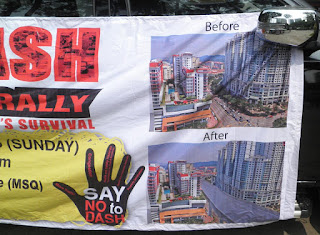
And to you Selangor Chief Minister Azmin Ali, re-route the DASH (Damansara-Shah Alam) Highway away from Damansara Perdana and Mutiara Damansara as their residents demand, and also do not let it run through the forest reserve land. These residents are not saying not to build the highway which will ease the traffic congestion for many but do not run it past their apartments and businesses and this is a reasonable demand.
Oh yes. Also don't allow a revival of the KiDEX highway which will run past my area.
Yours truly
Charles F. Moreira
http://aidmap227.blogspot.my/
Today, the website My Stock 118 jubilantly proclaims, "WE TOLD YOU SO"
We told you so – Ringgit Will Hit RM3.90 against the Dollar, As the 10 year MGS falls to best level in 52 weeks Our Reporter | March 31, 2016
Kuala Lumpur : We told you so that the Ringgit will hit RM3.90 against the US dollar. True enough the Ringgit touched RM3.90 against the dollar today, before being pushed up back to RM3.92 against the greenback.
More importantly, the risk on Malaysian assets have fallen drastically and dramatically. As it is, the ten year government debt securities yield with a ten year tenure, commonly known as the 10 year MGS (Malaysian Government Securities) now stands at 3.818 per cent.
This is the lowest the yield is at over a 52 week period. A lower yield means that, the risk of holding Malaysian debts have fallen.
http://www.mystock118.com/2016/03/31/we-told-you-so-ringgit-will-hit-rm3-90-against-the-dollar-as-the-10-year-mgs-falls-to-best-level-in-52-weeks/
Also, just yesterday evening at the Multimedia Super Corridor Project Management Professional (MSCPMP) Circle Forum #1/2006, entitled 2016 Outlook: A race to the bottom?, one of the speakers, Mr. Phua Lee Kerk, CFA, Chief Strategist with Phillip Capital, said that the contention over the 1MDB soveriegn fund is coming to an end and that he predicts that the ringgit will rise to RM3.80 to the US dollar later this year. Phua also told the audience that the Goods and Services Tax (GST) could be raised from the current 6% to 8% at the end of this year.
He also predicted that pending the outcome of the Sarawak State elections in April, the Prime Minister Dato' Sri Najib Tun Razak may well call a snap general election around June this year.
Another speaker, Soon Hoh Sing, an author, columnist and commentator from Klang, told me on the sidelines, that the Democratic Action Party (DAP) which gained some seats in the last Sarawak State elections, could well lose a few seats in the upcoming one, since some Chinese businessmen in Sarawak were angry with the former Sarawak Chief Minister Taib Mahmud, whose business interests allegedly were encroaching into those of these Chinese businessmen, but the current Sarawak Chief Minister Adenan Satem is more accommodating of other ethnicities, so it is quite likely that this segment of formerly aggrieved Chinese would vote for the ruling coalition again, since being pragmatic, they would not want to lose out on whatever opportunities there are available to them.
Now it may not please coffee and tea shop politicians that contrary to popular misconception, based upon whatever personal prejudices or biases - the ringgit's exchange rate has closely followed the price of oil, which began it plunge from US60 a barrel around June 2015 to below US$40 per barrel since November 2015.
* For those who are unfamiliar, the expression "coffee shop politician" refers to ordinary citizens who sit for hours in coffee shops (or pubs), sharing whatever snippet of political scandal or opinion, credible or incredible, informed or more often ill-informed, which they had heard from someone, who heard it from someone else, who heard it from someone else, who read it on some newspaper, website, blog, Facebook, Twitter, WhatsApp or whatever. In fact, I first heard the expression from my late mother back in the 1960s. She's Thai, so perhaps that's a Thai expression , though I'll have to ask my Thai friends and relations as to the origins of the expression.
The problem with this of course, is that people tend to believe what they want to believe, despite all the evidence on the contrary. Like if they insist on believing that the ringgit weakens whenever Najib farts, they will believe that whatever proof to the contrary you present them with.
Anyway, the two embedded charts below speak for themselves. (Allow viewing images in your e-mail client if you cannot see them.)
First the ringgit to dollar exchange rate over the past 12 months when went from a high of around RM3.50 to the US dollar to a low of almost RM4.46 to the US dollar in the last quarter of 2015

You can check out the exchange rate for yourself over here.
http://www.xe.com/
Now the crude oil prices - i.e. West Texas Intermediate and Brent

You can check that out for yourself over here
http://www.oil-price.net/
Looking at the above two charts, I'm sure that you can see a fairly close correlation between the ringgit-dollar exchange rate and the oil price.
However, the question remains as to whether the oil price will continue its rise from a low around the middle of this Q1 2016 - ending today 31 March, or is this rebound just a dead cat bounce, after which the oil price will fall again?
After all, both WTI and Brent crude prices have pulled back from slightly above US$40 per barrel to slightly below US$40 per barrel right now.
Well, Oil-Price.net is confident that the oil price will rise to US44 per barrel within the next 12 months.
Now, the lesson to be learned here is that Malaysia must move away from too much dependence on oil revenue and diversify our economy more, so that we will not be so adversely impacted by the price of this one commodity.
The implications
A weak ringgit versus other major and regional currencies negatively impacts upon the price of essential goods and to some extent services, since Malaysia imports much of our foodstuffs, including rice and the ingredients which go into processed foods and these are usually priced in US dollars.
Also, Malaysian manufacturers quite often import much of the raw materials, modules and component parts which go into their final products which they manufacture domestically, and these imports are priced in US dollars.
So, a weaker ringgit has a direct impact upon the cost of living for us ordinary folk, whilst hopefully, a stronger ringgit would result in lower prices on the shelves, provided the producers and suppliers will lower their prices accordingly.
Also, a lower cost of living will work favourably for the ruling Barisan Nasional coalition, especially for UMNO (United Malaysia National Organisation), its strongest member in Peninsular Malaysia, since a lower economic burden upon the rural and semi-rural folks, as well as the urban lower income group, will tend to favour the ruling coalition in terms of seats in parliament, especially since it's the rural and semi-rural constituencies which deliver the seats in parliament for the ruling coalition.
However, if the GST is raised to 8%, it could well negate the benefits of a stronger ringgit on us ordinary folk, so that's something the ruling coalition should think about, if it wants to remain in power, that is.
As for the opposition Pakatan Harapan, you better think of ways and means to address the concerns of us ordinary urban, rural and semi-rural folk as well, in real terms that is, not just well-worn and cliched platitudes such as "transparency, accountability, integrity", and so forth, if you want to become the next federal government.
Issues such as 1MDB, RM2.6 billion donation (or "donation"), Rosmah's ring, Altantuya, Scopene submarine, who had sex with whom through the front or back, Guan Eng's RM2.8 million bungalow, Mahthir versus Najib, etc. etc. etc. may provide much entertainment value for coffee shop politicians with too much time on their hands but these do not hit ordinary folk directly in the pocket where it hurts and will not deliver the majority of seats needed to win.
And to you Selangor Chief Minister Azmin Ali, re-route the DASH (Damansara-Shah Alam) Highway away from Damansara Perdana and Mutiara Damansara as their residents demand, and also do not let it run through the forest reserve land. These residents are not saying not to build the highway which will ease the traffic congestion for many but do not run it past their apartments and businesses and this is a reasonable demand.

Oh yes. Also don't allow a revival of the KiDEX highway which will run past my area.
Yours truly
Charles F. Moreira
http://aidmap227.blogspot.my/
25 March 2016
DON'T BE SURPRISED IF WINDOWS 7 OR WINDOWS 8 ON YOUR PC AUTO-UPDATES TO WINDOWS 10
Last Wednesday afternoon, a young lady was typing a short letter for her employer and complained that the PC was rebooting and interrupting her work, resulting in her taking longer than usual to finish her work.
The PC she was working on was running Windows 7 but when I saw the start up screen, I saw the word "Windows 10" and thought to myself "how on earth did this happen", since as far as I knew, one has to manually initiate the free upgrade from Windows 7 or Windows 8 to Windows 10, which Microsoft provides.
Fortunately, all files on the PC were intact after the upgrade had completed and all logins to e-mail were the same as before, and she was able to complete her work.
This young lady is not all that computer savvy, so I do not expect that she would know how to initiate an upgrade to Windows 10.
Since I have been running Linux on my PCs since late 2008, I have not had to face such issues with Windows, so when I got home that evening, I decided to find out whether there have been any known cases of Windows 7 or Windows 8 auto-upgrading to Windows 10, with or without the user's knowledge or intervention, so I did a Google Search on "Can Windows 10 auto-install itself?" and it pulled up many links saying YES, it can and does.
One of the best search results is the one below, which says that Microsoft now allows Windows 7 and Windows 8 to auto-update to Windows 10 from the first week of February 2016:-
Automatic Windows 10 installs begin but how easy are they to stop? - TechRepublic
By Nick Heath | February 2, 2016, 6:40 AM PST

Robert Galbraith/Reuters/Corbis
From Monday this week Windows 10 will automatically begin installing on many home machines running Windows 7 and 8.1.
Windows users will be able to stop the installation, as they will need to confirm they want the free upgrade to Windows 10 to continue.
But while it can be refused, the upgrade may repeatedly try to install itself on Windows 7 and 8.1 machines.
This marks the start of a new phase in the rollout of Windows 10: Microsoft has changed the status of the upgrade to that of a "recommended" update, which consumer Windows 7 and 8.1 machines typically attempt to install automatically on a regular basis.
When asked whether a Windows 7 and 8.1 machine will attempt to begin the install again after it's been declined, a Microsoft spokesman did not answer the question directly - stating only that users will be able to stop Windows 10 from installing by changing their Windows Update settings.
To stop the automatic upgrade from initiating, Windows Update settings will need to be changed from "Install updates automatically" to one of several options that allow users to choose which updates are downloaded and installed - as outlined here. Unticking the box marked "Give me recommended updates the same way I receive important updates" on the Windows Update settings page may also work.
If users do upgrade but don't like Windows 10 they will have 31 days to roll back to their previous OS.
Microsoft has previously not answered the question of whether the Windows 10 upgrade will repeatedly attempt to install on affected Windows 7 and 8.1 machines. When asked the same question last year, Jeremy Korst, general manager of the Windows and Devices team at Microsoft, said only that "the customer will have the ability to delay it for some period".
The Windows 10 upgrade is automatically being installed on many Windows 7 and 8.1 machines as a result of Microsoft changing the status of the upgrade to that of a "recommended" update.
Windows 7 and 8.1 machines sold to home users are generally configured to automatically install these "recommended" updates. Machines that have Automatic Updates turned on and the "Give me recommended updates the same way I receive important updates" option selected - Microsoft's recommended configuration when installing Windows 7 and 8.1 - will see the Windows 10 Upgrade begin to automatically install. The upgrade will be pushed to these machines as part of a phased rollout. The minority of computers that don't meet the relatively modest system requirements for Windows 10 will not receive the upgrade.
Enterprise IT administrators can disable the upgrade using Group Policy settings or by using the DisableUpgrade registry key. Microsoft advises that workarounds that rely on altering other registry keys are not "supported mechanisms" for controlling the upgrade process and are not recommended.
User numbers for Windows 10 are growing and earlier this year Microsoft announced that more than 200 million devices worldwide were running Windows 10. Among businesses, Terry Myerson, VP of Microsoft's Windows and Devices Group, said that more than 76 percent of enterprise customers were in "active pilots" and there were more than 22 million devices running Windows 10 across enterprise and education customers.
My first impression after the auto-upgrade was that it did not appear to slow down her work. However, Windows 10 is known to consume more memory and had disk space than Windows 7 and if it subsequently turns out that Windows 10 runs slower on that not very new PC, then it may be necessary to revert back to Windows 7. Microsoft allows for this within 31 days of an upgrade.
A Google search on "How to revert back from Windows 10 to Windows 7?" pulled up several descriptions of how this can be done.
One of the best being but you will need to backup your work files, just in case something goes wrong:-
Change your mind about Windows 10? Here's how you can roll back
CNET editor Dong Ngo shows you a quick way to roll back to your previous version of Windows if you just completed an in-place upgrade to Windows 10. Or, if you're completely happy with Windows 10, how to regain the storage space occupied by the previous Windows' files.
Editors' note: This post was updated on August 11, 2015, with the information on how to permanently remove previous Windows' files to restore storage space.
So Windows 10 is here and we think it's great . If you've already upgraded, but are feeling a little buyer's remorse (as much buyer's remorse as one can have for something that costs zero dollars), don't fret. We're here to help.
Microsoft gives you 30 days from the day you upgraded to Windows 10 to roll back to your previous version of Windows. Before you do so, however, it's a good idea to back up your data, even though it will remain intact.
(On the other hand, if you are totally happy with Windows 10 after the upgrade, make sure you check the bottom of the post for what you can do to gain your storage space, occupied by the previous Windows' files, back.)
All backed up? OK, let's get going.
Rolling back to previous Windows
 Enlarge Image First on the Start Menu, click on Settings. Screenshot by Dong Ngo/CNET
 Step 1: From the Windows 10 Start Menu, click on Settings.
 Enlarge Image On the Settings page click on the Update & Security button Screenshot by Dong Ngo/CNET
 Step 2: On the Settings page, click on the button that reads Update & Security...

Choose the Recovery option and then click on "Get Started," under "Go Back to Windows." Screenshot by Dong Ngo/CNET
Step 3: Now on the Update & Security page, click on Recovery and then under Go Back to Windows X (where "X" is the version of your previous Windows prior to upgrading to Windows 10), click on Get Started.

Pick a reason why you want to go back and then click on Next. Screenshot by Dong Ngo/CNET
Step 4: Select a reason for the rollback and then click Next.
After a warning and a confirmation, the rollback process will start. The process can take as short as a few minutes to about half an hour depending on the speed of your computer. In my experience, rolling back from Windows 10 to Windows 7 was much quicker (just about a fourth of the time) than my original upgrade process.
Note that once rolled back, you might have to reinstall some apps, and some of the settings changes you've made in applications may also be lost. Also, make sure you remember the log-in password for the previous version of Windows since the password for Windows 10, if you have changed it, will not stick, either.

Once rolled back you can re-upgrade to Windows 10 at any time. Screenshot by Dong Ngo/CNET
In case you're wondering why 30 days and not longer, Microsoft hopes that after this time you'll get used to Windows 10 enough and hence find no reason to go back. After the 30 days the Recovery function will be used in case you want to reset Windows 10 or roll back to a previous build of Windows 10.
So what if you want to roll back after the 30-day mark? There is at least one option: back up your previous version of Windows (7 or 8) using system backup software. You'll also need an external/secondary storage device to complete this. Personally, I'd recommend the free version of Macrium Reflect, which works smoothly and supports Windows 10.
Remove previous Windows' files
The reason you can roll back is that during the upgrade Windows 10 actually stores the entire previous Windows installation (and its software) on the computer's drive. This means a large amount of disk space, around 30GB, is used for this options. If you're completely happy with Windows 10 and feel there's no need to ever roll back, or you have an alternative backup of the previous Windows stored on an external drive, it's a good idea to remove these files to gain back the disk space. Here are the steps:
Step 1: Run Disk Cleanup. You can look for it using the search field on Windows 10's Taskbar, then click on it.

The Cleanup system files option will include previous Windows' installation. Screenshot by Dong Ngo/CNET
Step 2: Wait for the scanning to finish then click on Clean up system files.

Check the boxes for files you want to remove. Screenshot by Dong Ngo/CNET
Step 3: The scan will restart, once it's done, check the box in front of Previous Windows installation(s). Optionally, you can also safely check all other boxes. Then click on OK. Answer the confirmation prompt affirmatively and wait for the cleanup process to finish.
Obviously, after this you can't roll back to previous Windows version anymore, unless you had backed up the machine using third-party software prior to the upgrade to Windows 10.
Quite frankly, I think Microsoft is being rather unreasonable with PC users by imposing these auto-updates on them, which can catch many users unawares, especially if they do not know what's going on.
Install Linux on the PC and stop this nonsense once and for all?
Yes, I would love to but it's not my PC, so it's not up to me.
My journey to Linux began when I was unhappy with Windows Vista on a notebook I bought in 2007.
At first, I tried to install Windows XP from an original Windows XP install CD which I had but discovered that it did not recognise the SATA (Serial-ATA) hard disk on that notebook, since that copy of Windows XP was designed to support older PATA (Parallel-ATA) also known as IDE hard disks.
Worse, I had already wiped Windows Vista off the hard disk, and Hewlett-Packard would most probably have charged me a bomb to reinstall Windows Vista.
To have Windows XP recognise the SATA hard disk, I would have had to find the right Windows XP drivers for the SATA hard disk controller on that notebook and this proved difficult and moreover, I wondered whether I had rendered the hard disk unreadable.
Luckily I happened to have a Sabayon Linux install DVD which came with a copy of Linux Magazine which I had bought, so I booted it up and it recognised the SATA hard disk without problem, so I thought "What the heck! Go ahead and install it", which I did and there began my Linux journey, and I never looked back.
I later switched to Fedora Linux, then to Ubuntu Linux and now I run Linux Mint 17 on my main work desktop and Linux Debian 8 on my notebook and another desktop PC, both with the Cinnamon desktop. Rather interestingly, Debian 8 with the Cinnamon desktop also runs on an about 11 year old Benq Joybook 2000 notebook, my friend's son wanted to throw out, so she gave it to me and I restored it. Debian 8 is the latest stable version of Linux Debian and is the basis upon which Linux Ubuntu and Linux Mint were built.
The screen cap below shows the Cinnamon desktop on Linux Mint 17.
I have three office suites installed here. LibreOffice, WPS Office for Linux and Free Office.
LibreOffice is a free and open source office suite by the non-profit The Document Foundation.
You can download it from here and you can select the version for Windows, MacOS X or Linux as well as a choice of version for many different languages.
https://www.libreoffice.org/download/libreoffice-fresh/?version=5.1.1
WPS Office is an alternative to Microsoft Office developed by the China-based Kingsoft Corporation and is available in free and paid versions for Windows, Linux, Android and Apple iOS platforms
The personal editions of the four versions can be downloaded for free, except for the Business Edition (Premium) for Windows which costs US$79.99 lifetime license.
Free Office is by SoftMaker Software GmbH in Germany and runs on Windows, Linux and Android platforms.
It can be downloaded for free but you will have to provide your name, country and e-mail address.
http://www.freeoffice.com/en/download-freeoffice-mobile-office?id=1

So you actually have quite a few free of charge and legal alternatives to Microsoft Office, not only for your PC but for your phone or tablet as well.
The only thing you need to do after installation is to configure LibreOffice and Free Office to save your work in Microsoft Word, Excel and PowerPoint formats by default so that people using Microsoft Office can open them.
This is because, as it comes, LibreOffice (and Apache Open Office) by default saves such documents in .ODF (Open Document Format), whilst Free Office saves documents in its own format.
Free Office is a good choice if you want a basic office suite without too many bells and whistles, though it can only save your work in formats up to Microsoft Office 2003.
WPS Office looks a lot like Microsoft Office clone, which I find rather cumbersome to use.
LibreOffice is somewhat a balance between the above two and is the main office suite which I use. I installed the other two were installed just to try out. It can save your work in formats up to Microsoft Office 2013.
If you are wondering what is that "pdfsam" you see, well that is a utility which lets you split PDF documents into individual PDF pages and also to merge individual PDF documents into a single document. So if you only need a chapter or an article from a PDF document, you can use PDFSam to split a PDF file into individual pages, then merge selected PDF pages to create a PDF document featuring only the article or chapter you want.
PDF Sam for Windows and Mac can be downloaded from here.
Cheers
Charles
22 March 2016
REST IN PEACE, DEAR BROTHER VINCENT
Tuesday, March 22, 2016
It is with great sadness that we Michaelians (students and alumni of St. Michael's Institution, Ipoh) have heard that our beloved Dato' Brother Vincent Corkery passed on at Hospital Fatimah, Ipoh today, 22 March 2016. May God grant him eternal rest and bless his soul.His remains will be brought to St Michael's Church and the wake will be held tonight and Wednesday. Funeral is at 10.30am on Thursday, 24th March 2016.
http://smialumnikv.blogspot.my/
http://peterkhiew.blogspot.my/
Dato' Bro Vincent Corkery lived his commitment, dedication, personal sacrifice and perseverance which La Salle Brothers make in their lifelong quest to educate the young and to instil in them core ethics and values for success in their lives beyond school.
He was born in 1928 and grew up on his family's farm in Ireland till he joined the La Salle Brothers in 1942 and spent his Juniorate and Novitiate years in Castletown, where Brother Philip, a Brother Visitor convinced him to volunteer to serve in East Asia to help relieve the shortage of Brothers just after World War II.
He spent three more years studying for his Oxford School Certificate and his Oxford Higher School Certificate (A-Levels), then on 22 October, 1948, the start of his sea voyage to Singapore, where he taught at St. Patrick's School and later at St. Joseph's Institution.
He left to earn a Bachelor of Arts (Honours) and upon his returned to Singapore, and was posted to St. Michael's Institution, Ipoh, where he arrived on 31 December, 1957 as Sub-Director, a post he held for 13 years. He also taught sixth form students and was involved in administration.
Then away again to pursue a Post Graduate Certificate of Education at Cambridge University in 1969 and 1970, then Brother Vincent took over as Brother Director from Brother Ultan Paul who himself went for further studies, then served as Brother Visitor of the Penang District.
As Director, Brother Vincent introduced several radical reforms at St. Michael's , which improved SRP (LCE) results by 10% and boosted the class spirit in sports. He also represented St. Michael's at the Annual Conference of Heads of Secondary Schools in West Malaysia, served as its Secretary-General and helped restore the Old Michaelians' Association.
Brother Paul returned as Brother Director in 1976 until he retired 10 years later, so Brother Vincent returned to teaching which he so loved and devoted time to the Catholic Charismatic Movement. Brother Vincent took over as Brother Director again in 1986 until he retired in 1988, but continued to serve the wider LaSallian organisation and community in several ways.
What's the most inspriring period of his life? “Without hesitation it is the present, truly a life ever-dawning, so full of interest and excitement, an ever expanding universe of on-going discovery and invention, a world-wide merging of people of many faiths and traditions, and the maturing spirituality of human relations,” said Brother Vincent.
He will be sadly missed by many who knew him and were touched by his unfailing commitment and dedication as an educator and friend.
Our School Rally
https://www.youtube.com/watch?v=bzRabGU8Wjk
Based on the tune of O' Donnel Abu
https://www.youtube.com/watch?v=rY9jRmuVMyY
Charles F. Moreira
PS. His autobiography, Life Ever Dawning was published by the SMI Alumni Association Klang Valley and was officially launched at our Annual Dinner 2014 on 26th April.
It's available at St Michael's Institution, Ipoh (walk-in or email Peter Khiew for an appointment at peterkhiew@gmail.com).
Those in the Klang Valley can call our President Michael Lip ( 019-2225660) or Helen Lip (019-2216366) to get a copy of this marvellous book. An unsigned copy is priced at RM30 each and a signed copy at RM50.
REST IN PEACE, BROTHER VINCENT
 |
| |
http://smialumnikv.blogspot.my/
http://peterkhiew.blogspot.my/
Dato' Bro Vincent Corkery lived his commitment, dedication, personal sacrifice and perseverance which La Salle Brothers make in their lifelong quest to educate the young and to instil in them core ethics and values for success in their lives beyond school.
He was born in 1928 and grew up on his family's farm in Ireland till he joined the La Salle Brothers in 1942 and spent his Juniorate and Novitiate years in Castletown, where Brother Philip, a Brother Visitor convinced him to volunteer to serve in East Asia to help relieve the shortage of Brothers just after World War II.
He spent three more years studying for his Oxford School Certificate and his Oxford Higher School Certificate (A-Levels), then on 22 October, 1948, the start of his sea voyage to Singapore, where he taught at St. Patrick's School and later at St. Joseph's Institution.
He left to earn a Bachelor of Arts (Honours) and upon his returned to Singapore, and was posted to St. Michael's Institution, Ipoh, where he arrived on 31 December, 1957 as Sub-Director, a post he held for 13 years. He also taught sixth form students and was involved in administration.
Then away again to pursue a Post Graduate Certificate of Education at Cambridge University in 1969 and 1970, then Brother Vincent took over as Brother Director from Brother Ultan Paul who himself went for further studies, then served as Brother Visitor of the Penang District.
As Director, Brother Vincent introduced several radical reforms at St. Michael's , which improved SRP (LCE) results by 10% and boosted the class spirit in sports. He also represented St. Michael's at the Annual Conference of Heads of Secondary Schools in West Malaysia, served as its Secretary-General and helped restore the Old Michaelians' Association.
Brother Paul returned as Brother Director in 1976 until he retired 10 years later, so Brother Vincent returned to teaching which he so loved and devoted time to the Catholic Charismatic Movement. Brother Vincent took over as Brother Director again in 1986 until he retired in 1988, but continued to serve the wider LaSallian organisation and community in several ways.
What's the most inspriring period of his life? “Without hesitation it is the present, truly a life ever-dawning, so full of interest and excitement, an ever expanding universe of on-going discovery and invention, a world-wide merging of people of many faiths and traditions, and the maturing spirituality of human relations,” said Brother Vincent.
He will be sadly missed by many who knew him and were touched by his unfailing commitment and dedication as an educator and friend.
Our School Rally
https://www.youtube.com/watch?v=bzRabGU8Wjk
Based on the tune of O' Donnel Abu
https://www.youtube.com/watch?v=rY9jRmuVMyY
Charles F. Moreira
PS. His autobiography, Life Ever Dawning was published by the SMI Alumni Association Klang Valley and was officially launched at our Annual Dinner 2014 on 26th April.
It's available at St Michael's Institution, Ipoh (walk-in or email Peter Khiew for an appointment at peterkhiew@gmail.com).
Those in the Klang Valley can call our President Michael Lip ( 019-2225660) or Helen Lip (019-2216366) to get a copy of this marvellous book. An unsigned copy is priced at RM30 each and a signed copy at RM50.
Subscribe to:
Posts (Atom)